


Boiler Lockout: What to Do and How to Fix It (2026 Homeowner Guide)
- Darrell Williamson
- 2 days ago
- 12 min read
A boiler lockout isn't actually a failure of your system; it is a success of its safety protocols. Whilst it feels like a disaster when your home in Dartford or London goes cold, that flashing error code is your boiler protecting your household from potential hazards. If you are currently staring at a blank display or a cryptic symbol, you need to know about a boiler lockout what to do to get the warmth back safely.
We understand the frustration of having no hot water and the fear of expensive repair costs. It is stressful when you don't know if the fix is a simple button press or a major component replacement. This guide provides the immediate steps to safely diagnose the issue and resolve minor faults yourself whilst knowing exactly when to call a professional. We will walk you through common error codes, water pressure adjustments, and how to find a reliable Gas Safe registered engineer in Kent if your own efforts don't restore your heating immediately. You'll gain the clarity needed to handle this household crisis with total confidence.
Table of Contents
What is a Boiler Lockout and Why Does It Happen?
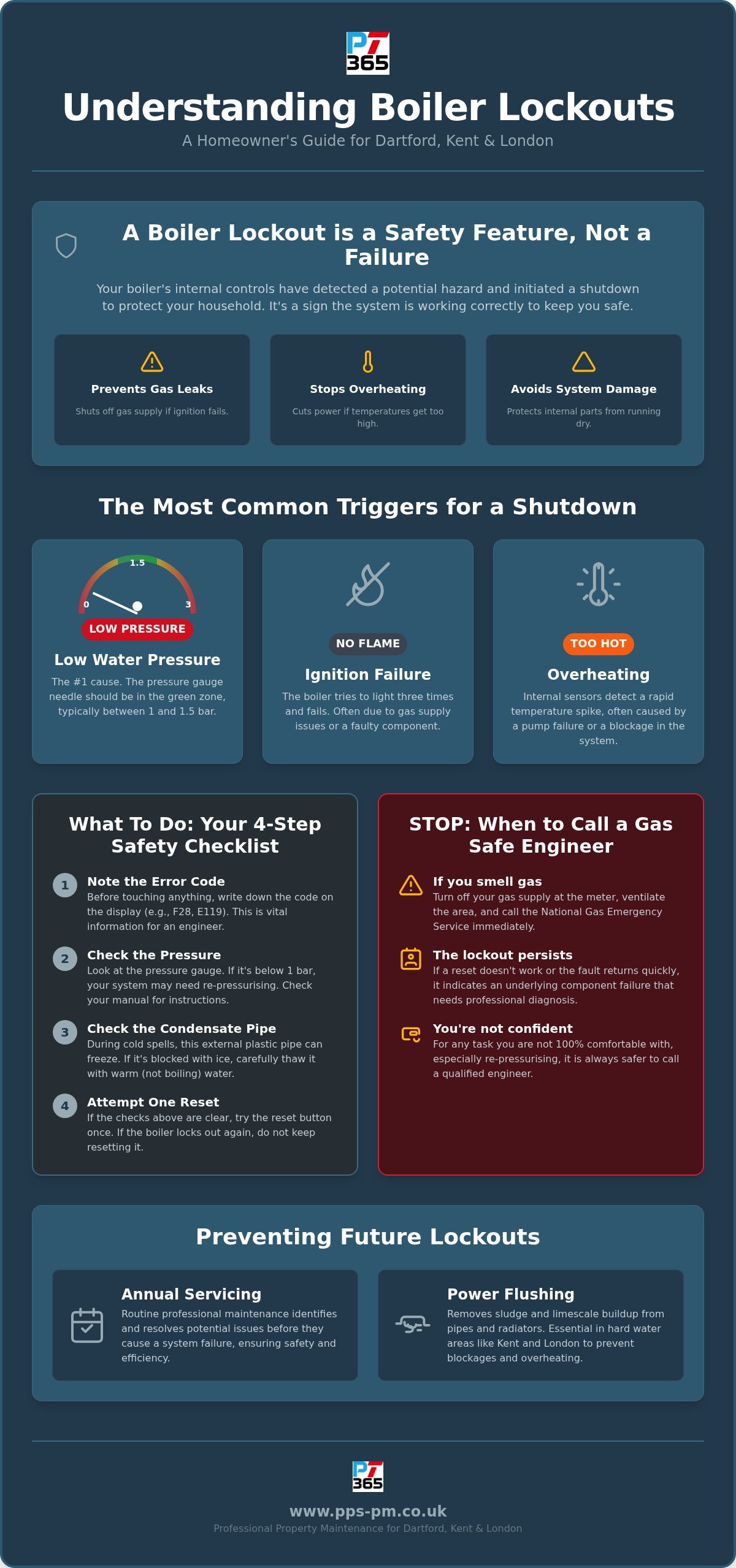
A boiler lockout is essentially your system's emergency brake. When the internal control board detects a potential hazard, it initiates a total shutdown to prevent damage to the unit or, more importantly, danger to your household. This isn't a random failure; it is a calculated response from a complex central heating system designed to keep you safe. By monitoring various parameters through sensitive internal sensors, the boiler ensures that gas pressure, water flow, and flue gases stay within safe operational limits.
To better understand this concept, watch this helpful video:
Understanding a boiler lockout what to do starts with recognising that this state is a protective measure. Without this feature, a faulty component could lead to serious issues like carbon monoxide leaks, extreme overheating, or even explosions. Sometimes, a lockout is simply a temporary glitch caused by a brief dip in gas pressure or a power surge. However, if the system shuts down repeatedly, it usually points to a persistent mechanical fault that requires professional attention from a qualified engineer.
The Most Common Triggers for a Shutdown
Most lockouts in Dartford and Kent homes stem from a few frequent culprits. These triggers are often the result of the system protecting itself from further internal damage.
Low water pressure: This is the most common reason for a sudden stop. For your system to function efficiently, the needle on the pressure gauge must stay between 1 and 1.5 bar. If it drops below this range, the boiler shuts down to prevent the heat exchanger from burning out.
Ignition failure: If the boiler tries to light three times and fails, it will lock out. This often happens due to issues with the gas supply, blocked burners, or faulty spark electrodes that can no longer produce a reliable flame.
Overheating: If the internal temperature spikes too quickly, the safety sensors will kill the power immediately. This is usually caused by a pump failure or a significant blockage within the pipes.
Visual Indicators of a Lockout
Identifying the problem is the first step in knowing a boiler lockout what to do. Your boiler communicates its status through several clear signs that something isn't right:
Display Panel Lights: Most modern units will show a flashing red or amber light on the fascia panel to grab your attention.
Alphanumeric Error Codes: Look for specific codes on the digital display. Common examples include F28 (ignition fault on Vaillant), E119 (low pressure on Baxi), or L2 (ignition fault on Ideal).
System Silence: If you turn up your thermostat and the boiler remains completely unresponsive with no fan or pump noise, it has likely entered a lockout state for safety reasons.
Decoding Boiler Error Codes: A Quick Reference
When your heating stops, the first thing you should do is look at the digital display on your boiler's front panel. Modern units use alphanumeric codes to tell you exactly what triggered the safety shutdown. If you are unsure about your boiler lockout what to do, always record this code before attempting a system reset. This information is vital for an engineer to understand the system's history. A reset might clear the display temporarily, but the underlying fault remains. Noting the specific code ensures that if you do need to call for assistance, the diagnosis is much faster.
Living in London or Kent presents a specific challenge for central heating: hard water. High mineral content leads to rapid limescale accumulation within the heat exchanger and internal pipework. This often triggers "circulation" or "low flow" error codes that might not appear as frequently in softer water regions. In areas like Dartford and Bromley, limescale acts like a thermal insulator. It forces the boiler to work harder, eventually causing a safety lockout due to overheating. If your boiler is locking out frequently with these specific codes, it might be time to speak with local boiler engineers near me to discuss a system clean.
Pressure-Related Fault Codes
These are the most common alerts homeowners encounter. You will typically see codes like F22 on a Vaillant or E119 on a Baxi. These codes signal that the water level inside the system is insufficient to operate safely. Many homeowners in Kent find that their pressure drops significantly after bleeding radiators to remove air pockets. A pressure gauge reading below 1.0 bar is the #1 cause of lockouts. High-pressure warnings are less common but usually indicate a failing expansion vessel or a filling loop that has been left slightly open.
Ignition and Gas Supply Issues
Codes such as EA (Worcester Bosch) or F28 (Vaillant) indicate that the boiler has failed to light after several attempts. If you see these, check your other gas appliances first. Lighting a ring on your gas hob is a quick way to rule out a wider grid supply issue. If the hob works, the problem is internal to the boiler. The flame sensor plays a critical role here; if it is covered in carbon soot or is faulty, it won't detect the flame even if it lights. This triggers an immediate safety lockout to prevent unburnt gas from building up inside the casing.
Boiler Lockout: What to Do (The Homeowner Checklist)
Facing a sudden system failure is stressful, but having a clear plan ensures you don't make the situation worse. If you are searching for a boiler lockout what to do, your first priority must always be safety. Start with these essential checks before attempting any mechanical intervention. Many lockouts are caused by external factors that you can identify without opening the boiler casing.
Check the pressure gauge: Look at the dial on the front of your boiler. If the needle has dipped below 1.0 bar, the system will shut down to protect the heat exchanger. You can usually top this up yourself using the filling loop until the needle sits comfortably between 1.0 and 1.5 bar.
Inspect the condensate pipe: During freezing winters in Kent and London, the external condensate pipe is a frequent point of failure. If this white plastic pipe freezes, waste liquid backs up into the boiler, triggering a safety shutdown.
Verify the gas supply: Ensure your gas meter has sufficient credit and that the isolation valve is in the open position. It is also worth checking if other gas appliances, such as your cooker, are functioning correctly to rule out a wider supply issue.
There is one vital rule to remember: the "One-Time Reset" rule. You should only attempt to reset your boiler once after performing these checks. If the system locks out again immediately, it is telling you that a genuine mechanical fault exists. Repeatedly forcing a reset can cause expensive damage to internal components and may mask a serious safety issue. If a single reset doesn't solve the problem, it is time to call a professional.
Step-by-Step: How to Safely Reset Your Boiler
Once you have confirmed that the pressure is correct and the gas is on, you can attempt a reset. Locate the reset control on the fascia panel. Depending on your model, this may be a button marked with an 'R', a flame icon with a line through it, or a specific dial setting. Press and hold this button for 3 to 5 seconds whilst the system reboots. Listen carefully as the boiler restarts. You should hear the fan begin to whir and the pump start to circulate water. If the pilot light ignites and the boiler remains operational, monitor it closely for the next hour.
Checking for External Blockages
A blocked flue is a serious safety concern that will trigger a lockout to prevent carbon monoxide buildup. Take a look at the flue terminal outside your home to ensure no debris, autumn leaves, or bird nests are obstructing the exhaust. If you suspect the issue is a frozen condensate pipe, you can gently pour warm water over the affected external area to thaw the ice. Never use boiling water, as the extreme temperature change can crack the plastic pipework. For more complex issues, you can read our Expert Boiler Repairs in London & Kent guide to see how we resolve persistent lockout issues for our local customers.
When to Stop: Identifying Faults That Require an Engineer
Knowing when to stop is the most critical part of understanding a boiler lockout what to do. Whilst basic checks on pressure and gas credit are safe for homeowners, there is a clear legal and safety boundary that you must not cross. In the UK, the Gas Safety (Installation and Use) Regulations 1998 mandate that only Gas Safe registered engineers can perform work on gas appliances. This includes opening the boiler casing or touching internal gas components. If your initial troubleshooting hasn't restored heat, you must prioritise the safety of your property over a quick DIY fix.
Ignoring a persistent lockout or attempting to "limp" a boiler by resetting it multiple times a day is a dangerous strategy. This behaviour often turns a minor component failure into a total system breakdown, potentially leading to an expensive boiler replacement. If you notice any of the following warning signs, shut off the gas supply and seek professional help immediately:
Unusual smells: A faint scent of gas or a sharp, metallic ozone smell that indicates electrical arcing on the control board.
Soot or scorch marks: Dark staining on the boiler casing or surrounding walls suggests incomplete combustion and a high risk of carbon monoxide leaks.
Loud banging or vibrating: Often described as "kettling," these aggressive noises signal a major internal blockage or a failing pump.
Why You Must Use a Gas Safe Registered Engineer
Safety is the primary reason for these strict regulations. Amateur repairs carry significant risks, including gas leaks, fires, and the silent danger of carbon monoxide poisoning. Furthermore, unauthorised work will immediately invalidate your manufacturer’s warranty. When an engineer arrives at your home in Dartford or Bromley, always ask to see their Gas Safe ID card. Check the back of the card to ensure they are qualified for the specific work required, such as "Gas Boiler." At Plumbfix 365, our team is fully committed to maintaining the highest standards of safety and compliance across all our local communities.
Major Component Failures
Persistent lockouts usually indicate that a major internal part has reached the end of its life. A seized pump will prevent water from moving, causing the boiler to overheat and shut down within seconds of firing. Similarly, a cracked heat exchanger or a malfunctioning fan will trigger a permanent lockout to ensure dangerous flue gases are not released into your living space. For reliable assistance, you can book our Professional Plumbing and Heating Services to get your system back online safely. If you are currently dealing with a cold home, contact our local boiler engineers near me for a rapid and professional diagnosis.
Preventing Future Lockouts: Long-Term Heating Reliability
Resolving an immediate system failure is a relief, but the ultimate goal is to ensure you never have to worry about a boiler lockout what to do again. Most emergency call-outs we attend in Dartford and Kent could be avoided with a proactive approach to system health. By investing in preventative care, you move from reactive repairs to a strategy of long-term reliability. The cornerstone of this strategy is the annual boiler service. This allows a qualified engineer to clean vital sensors and check combustion levels before they ever have the chance to trigger a safety shutdown.
In the Southeast, the high mineral content in our water supplies creates a specific challenge for central heating. Limescale and magnetite sludge build up inside your radiators and pipework over time. This causes the blockages and overheating that lead to frequent lockouts. A Power Flushing Service is the most effective way to deep-clean your system. This process removes the heavy debris that forces your boiler to work harder, significantly reducing the likelihood of a circulation-related failure. For landlords, this maintenance is even more critical; staying on top of CP12 checks ensures tenant safety and satisfies your legal obligations every twelve months.
The Benefits of Regular Maintenance in London & Kent
Consistent care offers more than just peace of mind. A well-maintained system operates at peak energy efficiency, which helps to keep your monthly fuel bills manageable. Regular checks also extend the lifespan of your unit by several years, helping you avoid the high cost of a premature replacement. You can learn more about how to protect your investment in The Homeowner’s Guide to Boiler Servicing.
Creating a "Heating Health" Plan
Modern technology makes it easier to monitor your system's condition. Upgrading to a smart thermostat can help you track performance and catch temperature spikes before they lead to a lockout. We also recommend several physical upgrades for homes in the London area to maintain a boiler lockout what to do prevention strategy:
Install a magnetic filter: This device sits on your return pipework and catches metallic debris before it can reach the boiler’s delicate internal parts.
Monthly pressure checks: Make it a habit to check your gauge on the first of every month. Catching a slow drop in pressure early can help you find a small leak before it leaves you with no hot water.
Upgrade insulation: Ensure your external condensate pipe is properly lagged to prevent freezing during the winter months.
Don't wait for the next cold snap to test your system's limits. Contact Plumbfix 365 for a comprehensive system health check today to ensure your home stays warm and your boiler remains reliable throughout the year.
Restore Your Home's Comfort and Safety
A boiler lockout is your system's way of prioritising your family's safety. By following our homeowner checklist, you can often identify simple issues like low pressure or a frozen condensate pipe without needing professional help. However, when the fault is persistent or involves internal gas components, knowing a boiler lockout what to do means recognising the legal and safety necessity of a qualified expert. Attempting complex DIY repairs can invalidate your warranty and, more importantly, put your household at risk.
Our Gas Safe Registered engineers provide rapid emergency response across Dartford, Bromley, and London postcodes. We take pride in our honest, transparent billing with no hidden fees, ensuring you receive high-quality heating restoration without any financial surprises. Need an urgent boiler repair? Contact our Gas Safe engineers in London and Kent today for 24/7 emergency support across Kent. Your comfort is our priority, and we're here to ensure your heating is back to peak performance as quickly as possible.
Frequently Asked Questions
Is a boiler lockout dangerous for my family?
A boiler lockout is not dangerous; it is actually a vital safety mechanism designed to protect your household. When internal sensors detect issues like overheating, gas pressure drops, or flue blockages, the system shuts down to prevent hazards such as carbon monoxide leaks. It is a clear sign that the boiler's safety protocols are working correctly to keep your property safe.
How many times can I try to reset my boiler before calling an engineer?
You should only attempt to reset your boiler once after performing basic external checks on your gas supply and water pressure. If the system fails to fire up or locks out again immediately, it indicates a genuine mechanical fault. Repeatedly forcing a reset can damage sensitive internal components like the control board and may lead to more expensive repairs later on.
Why does my boiler keep locking out even after I reset it?
If your system continues to shut down, it is likely due to a persistent internal fault that a simple reset cannot fix. This often involves a failing pump, a blocked heat exchanger, or a faulty sensor that no longer sends the correct signal to the control board. Professional diagnosis is necessary to identify the root cause and ensure the system is safe to operate.
Can low water pressure cause a boiler lockout?
Low water pressure is the most frequent reason for a sudden system shutdown in homes across Kent. Your boiler requires a specific water volume to circulate heat safely; if the gauge drops below 1.0 bar, the sensors will trigger a lockout. Learning how to top up the system via the filling loop is a key part of knowing a boiler lockout what to do.
What should I do if I smell gas near my locked-out boiler?
If you smell gas, you must immediately turn off your gas supply at the meter and evacuate the property. Don't operate any electrical switches or use naked flames, as these can trigger an explosion. Once you are safely outside, call the National Gas Emergency service and contact a Gas Safe registered engineer to inspect the appliance before you attempt to use it again.
Will a boiler service prevent future lockouts from occurring?
Regular annual servicing is the most effective way to prevent unexpected lockouts from disrupting your home. During a service, an engineer cleans the spark electrodes and flame sensors, which are common culprits for ignition failure. This proactive maintenance ensures your system remains reliable and efficient throughout the coldest months in Dartford and London, catching minor issues before they cause a total failure.
How much does it typically cost to fix a boiler lockout in London?
The cost of resolving a lockout varies significantly depending on the specific part that has failed. Whilst minor fixes like pressure adjustments or thawing a pipe are relatively inexpensive, replacing major components such as a PCB or heat exchanger will naturally involve higher costs. We recommend choosing a provider in the London area who offers honest, transparent billing to avoid hidden fees during a heating crisis.
Can a frozen pipe cause my boiler to go into lockout mode?
A frozen condensate pipe is a very common cause of lockouts during cold spells in Dartford and Bromley. When the external plastic pipe freezes, waste liquid cannot exit the boiler and backs up into the unit, triggering a safety sensor. Thawing the pipe gently with warm water usually clears the fault and allows you to reset the system for immediate warmth.


Comments