

Central Heating Water Treatment: A Professional Guide to System Longevity
- Darrell Williamson
- 2 hours ago
- 12 min read
Is your boiler working harder just to keep your home at a lower temperature than last year? It's a common frustration to see energy bills rise while radiators develop stubborn cold spots or the boiler begins to emit a concerning kettling noise. You likely feel that a standard annual service should prevent these issues, but the reality is that internal corrosion often bypasses basic checks. Professional central heating system cleaning is not just an optional extra; it's a vital restoration process that removes the magnetite sludge currently compromising your comfort and your wallet.
We understand the worry that comes with an inefficient system and the fear of a sudden, expensive breakdown. As a Local Power Flush Company, we see how a professional Central Heating Power Flush can revitalize aging pipework and restore heat distribution. This guide details how a Radiator Power Flush and targeted chemical treatments align with BS 7593:2019+A1:2024 standards. We'll explain why a Power Flush is a necessary investment for system health, highlighting the mechanical steps required to secure quieter operation, lower monthly costs, and total peace of mind for your home.
Key Takeaways
Understand how chemical balancing and professional central heating system cleaning prevent internal oxidation from damaging your boiler components.
Learn the difference between system cleaners that break down existing sludge and inhibitors that create a protective molecular film on your pipework.
Discover why your specific system architecture, especially open-vent setups, might be more prone to oxygen ingress and rapid internal corrosion.
Identify why a Central Heating Power Flush is a critical first step to ensure protective chemical treatments aren't wasted on a dirty system.
Explore the essential roles of magnetic filters and annual water testing to maintain long-term efficiency and comply with 2026 industry standards.
Table of Contents
What is Central Heating Water Treatment?
Central heating water treatment isn't a luxury; it's a technical necessity for any modern home. At its core, this process involves chemically balancing and cleaning the fluid that circulates within your radiators and pipework. In most UK properties, Hydronic heating systems use water as the primary medium to carry heat from the boiler to your living spaces. While water is an efficient conductor, it's also naturally aggressive toward the metallic components it inhabits. Without professional intervention, the very liquid designed to warm your home will slowly destroy the system from the inside out.
The primary enemy of your radiators and boiler heat exchanger is raw tap water. When you fill a system with untreated water, you're introducing dissolved oxygen and corrosive minerals into a closed-loop environment. Over time, heat cycles cause these elements to react with steel and copper, leading to internal oxidation. Professional central heating system cleaning shifts your system from a state of "dirty water" to "treated water." This transition is the hallmark of professional care, ensuring the liquid is no longer a corrosive agent but a stabilized, protective heat transfer fluid.
The Chemistry of Corrosion: Magnetite and Sludge
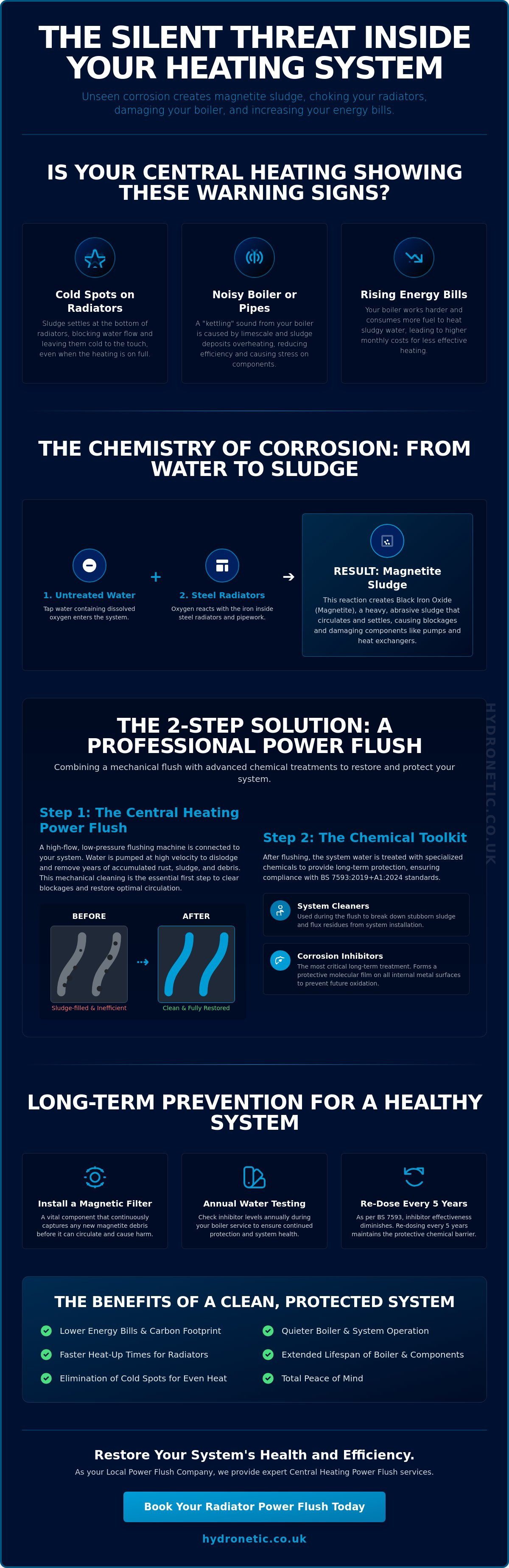
Corrosion starts when oxygen in the water reacts with the iron in your steel radiators. This chemical reaction produces black iron oxide, a heavy, metallic substance known as magnetite. As this debris circulates, it settles in low-flow areas, creating a thick, black sludge that restricts flow. You'll recognize the symptoms of untreated water through cold spots at the bottom of your radiators or "kettling" noises where the boiler sounds like a boiling kettle. Magnetite is the leading cause of circulation failure in UK homes. Left unchecked, this sludge hardens, leading to Boiler Blockage Clearance issues that can be far more expensive than preventative maintenance.
Why 2026 Efficiency Standards Demand Better Treatment
Modern high-efficiency condensing boilers are precision-engineered with narrow waterways to maximize heat transfer. Even a microscopic layer of magnetite on the heat exchanger can cause the boiler to overheat and cycle on and off frequently. This inefficiency doesn't just increase your bills; it also raises the carbon footprint of your household. By ensuring your system water is clean and chemically stabilized, you allow the boiler to operate at its designed peak. For older systems already suffering from debris, our Central Heating Power Flush Guide details how a mechanical Power Flush can restore original performance. As a Local Power Flush Company, we know that meeting 2026 efficiency standards requires a holistic approach to water health, combining a Radiator Power Flush with long-term chemical protection.
Types of Central Heating Cleaning Chemicals
Effective central heating system cleaning relies on a specific chemical toolkit designed to address different stages of a system's lifecycle. While many homeowners assume "cleaner" is a single product, professionals categorize these treatments into four distinct groups. Each plays a specialized role in maintaining the integrity of your pipework and boiler. Cleaners focus on breaking down established sludge and flux residues, while inhibitors are used to prevent new issues from forming. In specific scenarios, you may also require biocides or descalers to address biological growth or mineral deposits.
Inhibitors are perhaps the most vital component of long-term maintenance. These chemicals circulate within the system to create a protective molecular film on internal metal surfaces, effectively shielding them from the oxidation process. Maintaining properly treated water is a requirement of the BS 7593:2019+A1:2024 code of practice, which recommends re-dosing inhibitor every five years or performing a full laboratory test to confirm its effectiveness. Without this protection, even a clean system will quickly begin to corrode again.
For homes in hard water areas like Essex and Kent, descalers are often necessary to target limescale build-up that can choke a boiler heat exchanger. Similarly, low-temperature systems, such as underfloor heating, require biocides to prevent the growth of bacteria and fungi that thrive in lukewarm environments. If you're unsure which chemical balance your home requires, consulting a Local Power Flush Company ensures the right solution is applied to your specific system architecture.
Pre-Commission Cleaners for New Systems
It's a common misconception that new systems are clean. During installation, debris such as copper filings, solder flux residues, and factory grease can enter the pipework. If left inside, flux residues are highly corrosive and can cause localized pitting in a newly installed boiler within months. Using a pre-commission cleaner is a standard requirement to secure your manufacturer warranty. This initial treatment strips away installation contaminants, ensuring your new investment starts its life with a clean, stabilized environment.
Restorative Cleaners for Older Systems
Older systems with significant sludge build-up require heavy-duty restoration chemicals, often referred to as "sludge lifters." These are more aggressive than standard cleaners and are designed to mobilize hardened magnetite so it can be removed during a Radiator Power Flush. Depending on the level of contamination, these chemicals may need to circulate for several days before the actual Power Flush takes place. A professional technician will determine whether to use a pH-neutral cleaner, which is safer for delicate older components, or a stronger acidic descaler for severe blockages. This restorative approach is essential for Radiator Sludge Removal and returning your heating efficiency to its original levels.
Tailoring Treatment to Your System Architecture
Every heating system has a unique mechanical footprint that dictates its vulnerability to corrosion. While the chemicals used in central heating system cleaning are standardized, the method of application and the risks involved depend entirely on whether your home uses a pressurized sealed system or a traditional open-vented configuration. Oxygen is the primary catalyst for internal rust, and how your system interacts with the outside air determines how quickly magnetite will form. A one size fits all approach often fails to address the specific architectural weaknesses that lead to boiler failure.
Open-vent systems are inherently more susceptible to corrosion because they're "open" to the atmosphere via a tank in the loft. A common issue known as "pump over" occurs when water is accidentally discharged from the vent pipe back into the expansion tank. This process constantly aerates the water, introducing a fresh supply of oxygen that accelerates the rusting of steel radiators. When a Local Power Flush Company assesses your home, they look for these design flaws first. Identifying a "pump over" issue is vital; if the underlying plumbing fault isn't fixed, even the best chemical treatment will only offer a temporary reprieve.
Sealed systems, such as those powered by modern combi boilers, are designed to be airtight. However, they face different challenges. These systems operate at higher pressures, which means any leak leads to a rapid drop in pressure. When you use the filling loop to top up the system, you're introducing raw, oxygenated tap water. Frequent topping up is a silent killer for boilers, as it constantly feeds the corrosion cycle. Professional treatment for these systems requires specialized dosing tools to inject chemicals directly into the pressurized loop, ensuring even distribution throughout the pipework.
Treatment for Combi and Sealed Systems
Modern combi boilers rely on compact plate heat exchangers with incredibly narrow internal channels. Even microscopic debris can cause these components to seize, leading to fluctuating hot water temperatures. Maintaining expansion vessel health is a critical part of Sealed System Maintenance. If the vessel fails, the resulting pressure fluctuations force the safety valve to open, leading to the "fresh water" corrosion cycle mentioned above. Proper chemical dosing protects these sensitive parts from the inside out.
Special Considerations for Open Vent Systems
Traditional systems feature a Feed and Expansion (F&E) tank, which can become a breeding ground for biological sludge and collect dust or debris. Before dosing chemicals, this tank must be inspected and cleaned to prevent contaminants from being drawn into the main heating circuit. For older properties, Open Vent System Solutions often involve a combination of manual tank cleaning and gravity-fed chemical application. This ensures that the treatment reaches every radiator, even in systems with complex, aging pipework layouts.
The Synergy: Chemical Treatment and Power Flushing
Pouring expensive inhibitors into a system filled with black sludge is a common mistake that yields zero long-term benefit. For protective chemicals to work, they must bond directly with the internal metal surfaces of your radiators and pipework. If your system is contaminated, the inhibitor simply coats the debris, leaving the underlying metal vulnerable to ongoing corrosion. Chemicals alone aren't enough. Professional central heating system cleaning requires a mechanical element to be truly effective. A chemical treatment only loosens the problem; it takes a Central Heating Power Flush to actually remove it from your home.
Chemical surfactants play a critical role in Heating System Rust Removal by reducing the surface tension between the magnetite and the radiator walls. Once these bonds are broken, the debris is suspended in the water, but it remains inside the loop. Without high-velocity water flow, this detached sludge simply settles back into dead spots as soon as the pump stops. A professional Power Flush uses specialized pumps to create a high-flow, low-pressure environment, physically purging the suspended magnetite through a magnetic filter and out of the system.
The Professional Power Flush Process
A methodical approach is what separates a DIY attempt from a professional restoration. We begin by analyzing water turbidity and pH levels to determine the exact concentration of contaminants. Next, we circulate heavy-duty cleaners at high temperatures, as heat significantly increases the chemical reaction rate. During the Radiator Power Flush, each radiator is isolated and mechanically agitated using a specialized tool. This vibration dislodges stubborn black sludge that chemicals alone cannot reach, ensuring every corner of the system is clear. This process is the most effective method for total Radiator Sludge Removal.
Post-Flush Protection and Verification
Once the debris is removed, the system is flushed with fresh water until the Total Dissolved Solids (TDS) levels match your mains supply. This step is non-negotiable; leaving cleaning chemicals behind can lead to long-term component damage. Only after verification do we add a final dose of high-concentration inhibitor to protect the freshly cleaned metal. As a Local Power Flush Company, we provide a certificate of cleanliness upon completion. This document serves as vital evidence for insurance providers and validates your boiler warranty. We also adhere to the Environmental Protection Act 1990 for the safe disposal of all cleaning chemicals. If you're noticing cold spots or a noisy boiler, request a professional system assessment today to restore your heating efficiency.
Long-Term Prevention: Beyond the Chemical Bottle
Securing the longevity of your heating system requires more than a one-off chemical treatment. While restorative central heating system cleaning sets a clean baseline, maintaining that efficiency is an ongoing technical process. Modern industry standards have shifted from reactive repairs to a holistic, preventative maintenance model. Under the updated BS 7593:2019+A1:2024 code of practice, homeowners are now encouraged to adopt a rigorous aftercare routine that includes permanent filtration and regular water quality verification. This proactive approach ensures that the "peace of mind" achieved after a professional flush lasts for the decade to come.
Annual water testing is perhaps the most significant shift in modern system care. You can't see the chemical balance of your system water just by looking at it; clear water can still be highly corrosive if the inhibitor concentration has dropped. A professional water test confirms that your system remains protected against internal oxidation and identifies early warning signs of failure before they lead to a boiler breakdown. According to the latest standards, inhibitor should be re-dosed every five years, or a full laboratory test should be performed to confirm its continued effectiveness. Identifying these issues early prevents the need for repeated emergency interventions.
Installing and Maintaining Magnetic Filters
In 2026, the installation of an in-line magnetic filter is considered standard practice for protecting boiler components. These devices act as a continuous central heating system cleaning tool, capturing circulating magnetite before it can reach the sensitive boiler pump or heat exchanger. However, a filter is a secondary defense; it cannot remove established blockages that require a Central Heating Power Flush. For the filter to remain effective, it must be opened and cleaned during your annual service. Neglecting this simple step can lead to the filter becoming saturated, eventually restricting the very flow it was designed to protect.
The Hydronetic Power Flush Approach to System Health
We're committed to restoring home comfort through precision engineering and transparent service. Our goal is always to restore heat and efficiency to your existing pipework, often saving homeowners from the disruption of a new boiler installation. We provide specialist coverage across London, Essex, Kent, and Surrey, ensuring that local residents have access to expert Radiator Power Flush services and Boiler Blockage Clearance. To ensure your system is operating at its design potential, Contact Hydronetic Power Flush for a Professional System Health Check and secure your home's warmth for the future.
Securing Your Home’s Warmth for the Future
Maintaining a high-efficiency heating system requires a proactive approach that combines technical knowledge with the right mechanical tools. Relying on chemical inhibitors alone isn't enough if your pipework is already compromised by years of magnetite build-up. Professional central heating system cleaning restores the essential balance between water chemistry and mechanical flow, ensuring your boiler operates at its design peak. By integrating annual water testing and magnetic filtration, you move away from reactive repairs toward a model of long-term reliability and lower energy costs.
While optimizing your home's infrastructure is essential for long-term reliability, many homeowners are also looking at how advanced technology can improve their personal health. If you are interested in how molecular hydrogen can support your wellness journey, you can learn more about the PureONE generator.
Our team of specialist Power Flush engineers provides expert Boiler Blockage Clearance and comprehensive system restoration across London, Essex, Kent, and Surrey. We don't just treat symptoms; we rectify the underlying causes of cold spots and noisy operation to safeguard your domestic comfort. Don't let internal corrosion shorten the life of your heating system. Restore Your Heating Efficiency with a Specialist Power Flush and enjoy the peace of mind that comes with a healthy, validated home environment. Your radiators will be hotter, your bills will be lower, and your boiler will finally run as it was intended to.
Frequently Asked Questions
How often should central heating water be treated?
You should test your system water quality annually to ensure the protective chemical balance remains effective. According to the BS 7593:2019+A1:2024 standard, inhibitor should be re-dosed every five years, or a full laboratory test should confirm the water is still clean. If your system shows signs of sludge, a more intensive central heating system cleaning is recommended every five to ten years to maintain efficiency.
Can I add central heating inhibitor myself?
Homeowners can technically add inhibitor through a radiator towel rail or a filling loop, but this is often a wasted effort if the system is already contaminated. If magnetite sludge is present, the new chemical will simply coat the debris rather than protecting the metal pipework. A Local Power Flush Company, such as WellPlumbed, ensures the system is thoroughly purged before adding chemicals, making the treatment significantly more effective.
What are the signs that my heating system needs a chemical clean?
The most common indicators include cold spots at the bottom of radiators and concerning "kettling" noises from the boiler unit. You might also notice that the system takes much longer to warm up than it used to, or that the water is brown when you bleed the radiators. These symptoms suggest that a central heating system cleaning is necessary to remove the internal blockages causing these inefficiencies.
Is central heating water treatment different for underfloor heating?
Underfloor heating systems require a specialized chemical approach because they operate at lower temperatures that encourage biological growth. While standard radiators mostly deal with metallic corrosion, underfloor loops can develop a thick biological slime that restricts flow. Professionals use specific biocides in these systems to prevent bacterial colonies from forming, ensuring the narrow pipework remains clear and functional.
Will a power flush clear a completely blocked boiler?
A Central Heating Power Flush is highly effective for removing sludge, but it may not clear a total mechanical blockage in a heat exchanger. If the magnetite has hardened into a solid mass, you may require a specialized Boiler Blockage Clearance service or a component replacement. It's always best to have a technician assess the flow rate to determine if a flush can restore the system.
Does chemical treatment affect the warranty of my new boiler?
Professional water treatment is a mandatory requirement for almost all modern boiler warranties. Manufacturers specify that the system must be cleaned and treated in accordance with BS 7593 before the new unit is commissioned. Failing to provide evidence of this treatment, such as a certificate from a Power Flush, can lead to a warranty claim being rejected if the boiler fails due to sludge.
How long does a professional central heating water treatment take?
A comprehensive professional treatment, including a Radiator Power Flush, typically takes between four and six hours for a standard three-bedroom home. This timeframe allows for the chemicals to circulate at high temperatures and for each radiator to be individually agitated. More complex systems or those with severe Radiator Sludge Removal requirements may take a full day to complete properly.
What happens if I don’t use inhibitor in my radiators?
Omitting inhibitor allows raw tap water to react with the steel in your radiators, leading to rapid internal oxidation. This process creates magnetite sludge that settles in the bottom of radiators and eventually travels to the boiler. Without this protective chemical film, you'll face higher energy bills, frequent pump failures, and the eventual need for an expensive Central Heating Power Flush to save the system.


Comments