

Signs You Need a Power Flush: The 2026 Central Heating Health Check
- Darrell Williamson
- 3 hours ago
- 13 min read
Your heating system isn't just getting older; it is likely suffocating from the inside out as black iron oxide sludge restricts your pipes. You have probably noticed your energy bills creeping up despite no change in your usage, or perhaps you are tired of radiators that stay cold at the bottom no matter how high you turn the dial. It's frustrating to pay more for a home that feels less comfortable, particularly when your boiler starts making those concerning "kettling" noises. These are the classic signs you need a power flush before internal debris causes a total mechanical breakdown.
We understand that protecting your home in 2026 requires a methodical approach to maintenance. This guide will help you identify the critical warning signs of sludge so you can prevent a circulation issue from turning into a four thousand pound boiler replacement. You will learn how a professional Central Heating Power Flush restores heat distribution and why a Radiator Power Flush is often the most effective way to lower your monthly outgoings. We will provide a clear diagnostic checklist to use at home and explain why choosing a Local Power Flush Company provides the specialist expertise needed to ensure your long term domestic comfort.
Key Takeaways
Learn how a systematic health check identifies "silent symptoms" that contribute to the majority of boiler failures before they lead to a total breakdown.
Use our diagnostic checklist to spot the physical signs you need a power flush, such as cold radiator bases and discoloured water during bleeding.
Understand the "Magnetite Menace" and how black iron oxide sludge restricts heat flow while driving up your monthly energy consumption.
Evaluate the long-term ROI of a Central Heating Power Flush by comparing maintenance costs against the significant expense of replacing blocked heat exchangers.
Discover how a specialized Local Power Flush Company uses high-velocity, low-pressure technology to safely clear debris from your heating system.
Table of Contents
What is a Central Heating Health Check?
A Central Heating Health Check is a systematic diagnostic audit designed to assess the internal condition of your boiler, pipework, and radiators. While a standard boiler service focuses primarily on gas safety and mechanical components, a health check investigates the water quality and circulation efficiency. It's a proactive way to identify the early signs you need a power flush before they escalate into a total system failure. In 2026, where energy costs remain a primary concern for homeowners, establishing a baseline for your Central heating system is the first step toward long-term efficiency.
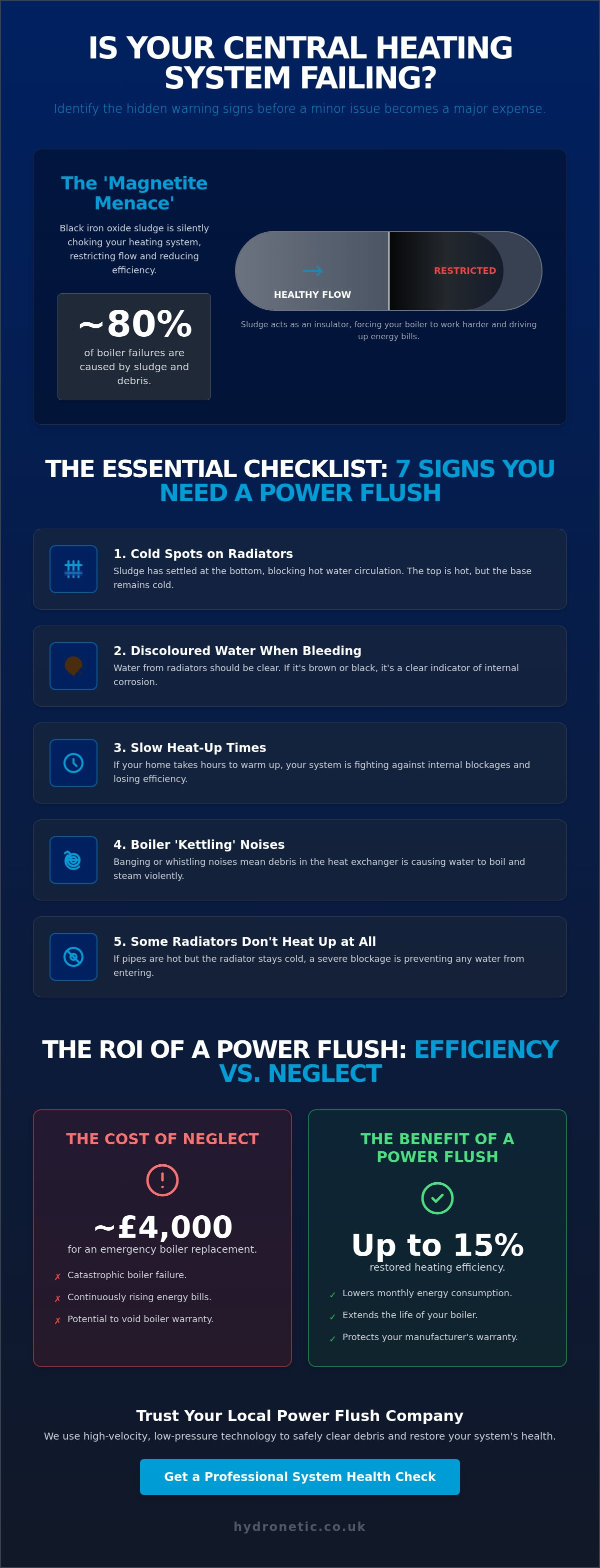
Most boiler breakdowns aren't sudden accidents. They are the result of "silent symptoms" that have been building up for years. Industry data indicates that approximately 80% of boiler failures are caused by sludge and debris within the system. By identifying these issues early, we can distinguish between simple component wear and the need for a comprehensive Central Heating Power Flush. This assessment provides a technical snapshot of your system, ensuring you aren't wasting money on heating that never reaches your living spaces.
Why proactive monitoring beats reactive repairs
Sludge, or magnetite, is a dense, black substance that forms when internal components corrode. It acts as an insulator, coating the inside of your heat exchanger and radiators. This forces your boiler to burn more gas to achieve the same temperature, which can lead to a drop in heating efficiency of as much as 15%. For a typical household, this translates to hundreds of pounds wasted on energy bills every year because the system is fighting against its own internal blockages.
Choosing a Local Power Flush Company is vital because water chemistry varies significantly across the UK. In London and the South East, high mineral content in the water can accelerate scale formation when mixed with magnetite. A specialist who understands these regional variations can provide a more accurate assessment of your system's health and recommend the correct chemical inhibitors to prevent future corrosion.
The role of the 'Health Check' in boiler warranty
Protecting your investment is about more than just comfort. Many modern boiler manufacturers stipulate that their warranties are only valid if the system is kept clean and treated with appropriate inhibitors. If a heat exchanger fails due to sludge, the manufacturer may refuse to cover the repair cost if there is no evidence of a recent Radiator Power Flush or system cleanse. A health check provides the documentation you need to prove your system has been maintained to professional standards.
A health check helps you differentiate between a minor, localized blockage and a systemic issue. If only one radiator is cold, it might be a simple valve problem. However, if multiple radiators show cold spots or the boiler is making "kettling" noises, these are definitive signs you need a power flush. Taking action now ensures your boiler remains protected and your warranty stays intact, avoiding the high costs of emergency repairs or premature replacement.
The Essential Checklist: 7 Signs You Need a Power Flush
Your heating system communicates its health through specific signals. While some issues appear suddenly, most develop over years as magnetite sludge accumulates within the pipework. Identifying the signs you need a power flush early can save you from a total system shutdown during the coldest months of the year. If you find yourself adjusting the thermostat higher without feeling any warmer, it's time to run through this diagnostic checklist.
Cold spots on radiators: If the bottom or middle of your radiator feels cold while the top is hot, sludge has likely settled at the base, preventing hot water from circulating.
Discoloured water: When you bleed your radiators, the water should be clear. If it's brown or black, you have an active corrosion problem.
Slow heat-up times: A healthy system should reach temperature quickly. If your house takes hours to get warm, sludge is acting as an insulator.
Boiler kettling: Banging or whistling noises from the boiler suggest that debris is trapped in the heat exchanger, causing water to overheat and turn to steam.
Radiators that won't heat: If the copper pipes leading to a radiator are hot but the radiator itself remains stone cold, a blockage is likely restricted to that specific unit.
Cloudy tap water: In some systems, internal debris can affect the heat exchanger responsible for your domestic hot water.
Frequent pump failure: If your central heating pump has been replaced multiple times, it's probably because it's struggling to push thick, sludgy water through the system.
Visual and Auditory Warning Signs
You don't need a toolkit to perform a basic health check. The "Magnet Test" is a highly effective way to confirm the presence of magnetite at home. Simply run a high-strength magnet along your radiator or copper pipework. If the magnet sticks to the pipe, it indicates a significant buildup of iron oxide debris inside. This debris is the primary cause of "kettling," a sound similar to a boiling kettle that signals your boiler is struggling to shed heat. You should also check your central heating pump; if it's vibrating excessively or feels too hot to touch, it's working under extreme stress. If you notice these symptoms, you can request a professional assessment from a specialist technician.
Performance-Based Indicators
Internal blockages often manifest as inconsistent performance in modern conventional heating systems. You might notice your shower temperature fluctuating or the boiler "short-cycling," where it turns on and off frequently without ever reaching the target temperature on your thermostat. This happens because the boiler detects an internal overheat due to restricted flow and shuts down as a safety precaution. In these instances, a targeted Boiler Blockage Clearance is often the only way to restore the system to its original design specifications. Recognizing these signs you need a power flush allows you to act before the sludge causes permanent damage to sensitive internal components.
Understanding the 'Magnetite Menace': What’s Hiding in Your Pipes?
Many homeowners assume the black liquid found in their heating water is simply dirt. In reality, it is a technical byproduct known as Black Iron Oxide, or Magnetite. This substance is the result of the corrosion process in central heating systems, where internal steel and iron components slowly break down over time. When these microscopic metal particles detach, they circulate through your pipework, eventually settling in areas with lower water velocity. This is precisely why the bottom of your radiators often feels cold; the sludge has created a dense, insulating barrier that prevents hot water from reaching the metal surface.
In London and the South East, this issue is exacerbated by the region's notoriously hard water. While magnetite is a product of corrosion, limescale is a product of mineral deposits. When these two substances combine, they create a stubborn, cement-like blockage that is significantly harder to remove than standard sludge. This chemical cocktail increases internal friction, forcing your pump to work harder and creating more turbulence, which in turn accelerates further corrosion. Recognizing the signs you need a power flush becomes even more critical in hard water areas to prevent these deposits from becoming permanent.
The chemistry of corrosion in sealed systems
Even in modern sealed systems, oxygen ingress can occur through microscopic leaks or during routine maintenance. Magnetite forms when iron, water, and oxygen react. While "soft" sludge can often be disturbed by high-velocity water, hardened limescale requires specific chemical loosening during a Radiator Power Flush. If left untreated, this "Magnetite Menace" will eventually migrate to the boiler's heat exchanger, leading to the "kettling" noises mentioned previously and potentially causing a total system blockage.
Why 'Bleeding' isn't enough
A common mistake is believing that bleeding a radiator will clear the system. Bleeding is only designed to remove trapped air from the top of the unit. It does nothing to address the heavy, metallic sludge sitting at the bottom. In fact, if you continue to bleed a system that is heavily restricted by debris, you may actually introduce more fresh, oxygenated water, which feeds the corrosion cycle. This is one of the subtle signs you need a power flush; if you are bleeding your radiators monthly, you are likely masking a much deeper circulation problem.
DIY attempts to clear sludge often result in localized airlocks or significant mess when the black liquid escapes. When you observe heavy debris in the system, it is time to stop manual interventions. A Local Power Flush Company uses specialized pumping equipment to ensure the debris is physically removed from the property rather than just moved to a different part of the pipework. This professional Central Heating Power Flush is the only way to ensure the "Magnetite Menace" is fully eradicated from your home.
The ROI of a Power Flush: Efficiency vs. Neglect
Many homeowners view maintenance as an optional expense, but ignoring the signs you need a power flush is a costly oversight. When your system is restricted by sludge, you are essentially paying a "neglect tax" through inflated energy bills and premature equipment failure. A professional Central Heating Power Flush isn't just a cleaning service; it's a strategic investment in your property's infrastructure that yields measurable financial returns. It's about restoring the system to its original design specifications to ensure every pound you spend on gas actually heats your home.
The cost-to-benefit ratio is clear. Replacing a blocked heat exchanger or a failed pump is expensive, and a full boiler replacement in 2026 can cost several thousand pounds. In contrast, a Power Flush restores the entire system for a fraction of that amount. Verified industry data shows that removing internal debris can reduce gas consumption by up to 25%. For the average household, this means the service can pay for itself through energy savings within just 2-3 heating seasons, depending on your usage patterns.
Longevity is another critical factor in your return on investment. A clean system can extend your boiler's lifespan by an estimated 5-10 years by reducing the mechanical stress on internal components. By eliminating abrasive magnetite particles, you protect the pump and diverter valve from excessive wear and tear. This provides a level of "peace of mind" that's invaluable, especially when it helps you avoid the stress and expense of mid-winter emergency call-outs.
Protecting your boiler and hot water flow
A major advantage of this procedure is ensuring optimal hot water flow to your taps and showers. Sludge often creates "dead spots" within the heat exchanger where water cannot circulate effectively. These areas become prone to overheating, which causes the metal to expand and contract unevenly, eventually leading to structural cracks. After a Radiator Power Flush, we always advise the installation of a magnetic filter. This component acts as a permanent shield, capturing any new metallic particles before they can settle and cause further damage.
Environmental and Financial Benefits
Improving your system's thermal efficiency directly lowers your home's carbon footprint. An efficient boiler burns less fuel to maintain a comfortable temperature, which is essential as we move toward stricter environmental standards in 2026. By identifying the signs you need a power flush early, you avoid the "poverty trap" of inefficient heating, where you're forced to spend more money for a colder home. As a Local Power Flush Company, we focus on delivering long-term value that keeps your home warm and your bills manageable.
Taking Action: How Hydronetic Power Flush Restores Your System
Once you have identified the signs you need a power flush, the next step is choosing a methodology that protects your system while effectively removing years of debris. At Hydronetic Power Flush, we operate as a specialized Local Power Flush Company with a focus on technical restoration rather than just a quick rinse. Our approach utilizes high-velocity, low-pressure pumping. This distinction is vital for homeowners; high pressure can cause leaks in weakened joints or older pipework, whereas our high-velocity method safely scours the internal pipe walls using speed and chemical action rather than brute force.
Our technical process follows a rigorous 3-stage chemical cleaning cycle. First, we introduce mobilizing agents that break down the hardened magnetite and limescale blockages. Second, we flush each radiator individually, concentrating the full flow of the machine on one unit at a time to ensure every gram of debris is physically removed from the property. Finally, we perform a total system balance and add a high-grade inhibitor treatment. This final step is essential for long-term protection, as it creates a chemical barrier that prevents the return of the corrosion cycle in 2026 and beyond.
What to expect during a Hydronetic Power Flush service
We understand that inviting technicians into your home requires a high degree of trust. We prioritize a "no mess, no fuss" policy, using protective floor coverings and sealed connections to safeguard your carpets and furniture throughout the day. A thorough Central Heating Power Flush is not a two-hour job. For a typical 3-bedroom home, the process takes a full day to ensure every radiator is cleared and the water is chemically neutral. We verify our results using thermal imaging cameras or flow meters, providing you with visual proof that the cold spots are gone and the heat distribution is once again uniform.
Next steps for your central heating health check
If you are experiencing inconsistent heating or rising bills in Essex, Kent, or Surrey, booking a professional assessment is the most logical path forward. While a general plumber might offer a basic flush as part of a wider service, choosing a specialist ensures you benefit from industrial-grade equipment and dedicated expertise. A Radiator Power Flush is a precision task that requires a deep understanding of system hydraulics to be effective. Recognizing the signs you need a power flush is the first step; the second is ensuring the work is carried out to the highest professional standards. Book your Central Heating Health Check with Hydronetic Power Flush today to restore your home's comfort and efficiency.
Securing Your Home's Long-Term Heating Efficiency
Sludge accumulation is a progressive issue that compromises both your comfort and your finances. By proactively identifying the signs you need a power flush, you can intervene before magnetite causes permanent damage to your heat exchanger. A professional Central Heating Power Flush restores the flow of heat throughout your home, ensuring your energy bills reflect your actual usage rather than the cost of fighting internal blockages. This methodical approach to maintenance is the most effective way to safeguard your property against the "Magnetite Menace" while maximizing the lifespan of your boiler.
As a specialist Local Power Flush Company, Hydronetic Power Flush provides expert Radiator Power Flush techniques and dedicated Boiler Blockage Clearance experts across London, Essex, Kent, and Surrey. We focus on technical precision to ensure your system operates at peak performance for years to come. Don't wait for a total system failure to take action; a proactive health check offers the peace of mind that comes with a reliable, efficient home. Get a Specialist Quote for your Central Heating Power Flush today and let us help you restore your system's health with technical competence and transparency.
Frequently Asked Questions
Is a Power Flush worth it for an old heating system?
Yes, a Central Heating Power Flush is highly beneficial for older systems as it removes years of accumulated magnetite. By clearing these blockages, you reduce the strain on aging components and potentially delay the need for a full replacement. It's a cost-effective way to restore performance without the upheaval of a new installation.
Can a Power Flush cause leaks in my radiators?
A Power Flush does not cause leaks; however, it can uncover existing corrosion that was previously "plugged" by sludge. We use high-velocity, low-pressure pumping specifically to protect older pipes. If a radiator is so corroded that it leaks during the process, it was already a safety risk that would have eventually failed during the winter.
How often should a central heating system be power flushed?
Most experts recommend a professional service every 5 to 6 years to maintain peak efficiency. However, you should book an assessment immediately if you notice the physical signs you need a power flush, such as cold radiator bases or a noisy boiler. Regular maintenance prevents the "Magnetite Menace" from causing permanent damage to your heat exchanger.
Will a Power Flush make my house warmer immediately?
Yes, you will notice a significant improvement in heat distribution as soon as the system is refilled and balanced. By removing the insulating layer of sludge, the water can transfer heat to the radiator surface much more effectively. Your rooms will reach the target temperature faster, allowing your boiler to cycle off sooner and save you money.
Can I power flush a combi boiler system myself?
No, you shouldn't attempt to power flush a combi boiler system yourself. It requires specialized high-flow pumps and professional-grade chemicals that aren't available to the general public. As a Local Power Flush Company, we have seen many DIY attempts result in severe airlocks or internal boiler damage that costs far more to repair than the original service.
How long does a professional Power Flush take to complete?
A thorough Radiator Power Flush typically takes between 6 and 10 hours to complete correctly. The exact duration depends on the number of radiators and the severity of the sludge buildup. We focus on flushing each unit individually until the water runs clear, which is why a professional job cannot be rushed into a few hours.
What is the difference between a chemical clean and a Power Flush?
A chemical clean is a passive process where cleaner is added to the system for a few days, whereas a Power Flush is an active mechanical removal. The machine provides the velocity needed to physically lift heavy iron oxide particles out of the system. While chemicals are used during the flush, the machine is what ensures the debris actually leaves your home.
Do I need a Power Flush before installing a new boiler?
Yes, most manufacturers require a full system cleanse before a new boiler is commissioned to protect the warranty. Installing a new boiler onto a dirty system will quickly contaminate the new heat exchanger with old sludge. A Central Heating Power Flush ensures your new investment starts its life in a clean, protected environment.


Comments