

Local Carpenters Near Me: Commercial Carpentry Maintenance Explained
What if a sticking door or damaged window is a sign that several repairs need attention across your property? Local carpenters near me can help with individual jobs, but commercial properties often benefit when repairs are planned as part of wider maintenance.
It can be difficult to organise work around tenants, staff or vacant units, especially when the scope and access arrangements aren’t clear. This guide explains carpentry repairs that can support commercial properties, from door hanging and window fitting to void works and general repairs. It also covers how to organise planned and reactive maintenance, share property requirements and keep work coordinated.
With over 30 years of experience, the property maintenance team supports businesses, landlords, letting agents and management companies. Dedicated account management and photographic job reports help property professionals track completed work. The company is 100% Gas Safe Registered and holds £5 million public liability insurance. For enquiries, call 01322 252015 or 01322 251520.
Table of Contents
What does commercial carpentry maintenance cover in a property?
How commercial carpentry maintenance fits a property upkeep plan
Carpentry call-outs or coordinated property maintenance: what differs?
What to prepare before arranging commercial carpentry maintenance
Arrange carpentry maintenance with a trusted property maintenance team
What does commercial carpentry maintenance cover in a property?
Commercial carpentry maintenance is planned or reactive work that maintains a property’s fixtures and fabric. It can include fitting or repairing doors and windows, void-work carpentry and related handyman tasks. The precise work depends on the defect and the property brief. For a general introduction to the trade, see Carpentry.
A small defect can affect how a space is used and presented. A door that catches may make access awkward; damaged fittings or a window that does not close as intended may need prompt attention. In an occupied property, these issues can interrupt day-to-day use. In a vacant unit, they may form part of the work needed before the space is ready for its next use.
For property teams comparing options for Local carpenters near me, the useful starting point is the specific fixture and the problem observed. Carpentry maintenance focuses on repairs and fittings. It is distinct from structural building work, which is outside the scope described here.
Which carpentry jobs arise in commercial properties?
Void-work carpentry may include hanging a door or repairing an existing one. Window fitting and repairs may also be needed, depending on the property requirement. Handyman work can address other practical repair tasks within a maintenance brief. The description should identify the affected fixture and what is wrong with it, rather than assume that every door or window needs the same work.
For example, note whether a door is loose, damaged or difficult to use, and identify which window needs attention. Clear details help define the task. The right response depends on the defect, the property and the agreed brief.
When does a repair become part of wider property maintenance?
A single carpentry issue can be handled as a reactive repair. If several known tasks need attention, property teams can group them into planned maintenance, helping them organise the work around the property’s needs. The brief might cover separate doors, windows or other carpentry repairs, rather than treating each item as an unrelated request.
A wider refurbishment has a broader scope than maintaining or repairing a fixture. Kitchen installation and repairs are examples of property refurbishment work; they shouldn’t be confused with structural building work. Carpentry may sit alongside other agreed upkeep tasks, while decorating can form a separate part of a property brief. For related guidance on organising upkeep that includes decorating, see this professional painter and decorator guide.
Keep the work description specific. Record the location, the fixture and the visible issue, then set out whether the request concerns one repair or several tasks. That gives the maintenance brief a clear starting point without assuming that a small defect calls for a larger refurbishment.
How commercial carpentry maintenance fits a property upkeep plan
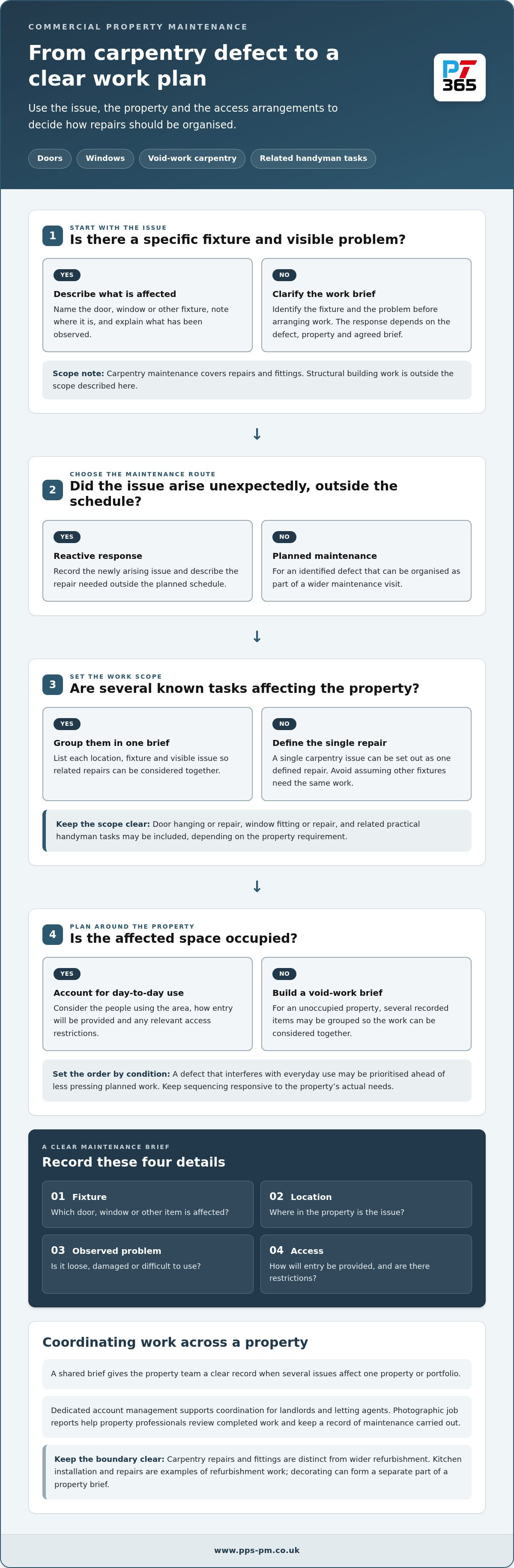
A property upkeep plan helps teams decide which carpentry jobs to schedule together and which defects need a reactive response. Start by recording known issues, their locations and how they affect use of the space. Then consider the property’s condition, occupancy and access arrangements before setting the order of work. The work plan should reflect the property brief.
Planned work suits defects that have been identified and can be organised as part of a wider maintenance visit. A reactive response is for an issue that arises unexpectedly and needs attention outside that schedule. The distinction helps property teams describe what needs doing and communicate whether work can be grouped or needs separate coordination.
Planning carpentry work across occupied and vacant properties
A void-work brief can focus on preparing an unoccupied property, while work in an occupied space needs to account for people using the area. Describe the affected door, window or other fixture, where it is, and what has been observed. Include access arrangements, such as how entry will be provided and any relevant restrictions. Clear details help the team organise the visit around the property.
Property condition also affects sequencing. A defect that interferes with everyday use may need to be prioritised ahead of less pressing planned work. For a vacant unit, several recorded items may be grouped in a single brief so the work can be considered together. Keep the order responsive to the actual condition and requirements, rather than applying the same schedule to every property.
Coordinating carpentry with other maintenance tasks
Grouping related repairs can simplify communication when several issues affect one property or portfolio. A shared brief gives the property team a clear record of the requested work, while dedicated account management supports landlords and letting agents as jobs are coordinated. Photographic job reports can also help property professionals review completed work and maintain a record of the maintenance carried out.
Joined-up upkeep means seeing carpentry as part of the property’s broader maintenance needs, without assuming every repair requires a refurbishment. The professional property maintenance guide offers a related view of how upkeep can be organised. PlumbTech365 Property Services is 100% Gas Safe Registered and holds £5 million public liability insurance.
If you’re organising carpentry alongside other property repairs, discuss a coordinated maintenance brief with PlumbTech365 Property Services.
Carpentry call-outs or coordinated property maintenance: what differs?
A single carpentry call-out sets out one defined repair. Coordinated property maintenance brings several tasks together under a broader brief. The right approach depends on the property, the condition of its fixtures and how much work needs organising. A clear scope helps property teams communicate the request and plan access without assuming every issue belongs in the same visit.
When might a single carpentry repair be the right brief?
A focused request can suit a clearly identified issue, such as a damaged door or a window needing attention. Describe where the fixture is and what you have observed. That gives the repair a defined starting point and keeps the brief specific. A single request doesn’t mean the issue is necessarily isolated; the property team may have other work to record separately.
When can a coordinated maintenance brief help?
A wider brief can help when carpentry is one item among several property tasks, such as repairs identified during a void inspection. Grouping them gives the team a shared view of the requested work and the communication it needs. Photographic job reports can help landlords and property managers review and record completed tasks across a maintenance brief.
The main difference is scope: a single-trade request centres on one carpentry job, while coordinated maintenance organises carpentry alongside other agreed property tasks. Neither approach is automatically the right fit for every property. Consider how many issues need attention, whether they relate to one another, and how access will be arranged. A broader brief may also help identify related work that wasn’t part of the original carpentry request, so keep any newly identified task distinct and agree it before it proceeds.
For property professionals, dedicated account management provides a point of coordination for maintenance requests, while job reports with photographs offer a record of work carried out. This can be useful when overseeing several tasks or properties. For larger premises undergoing complete office or facility upgrades, turnkey commercial specialists like a1precision.com.au illustrate how extensive building modifications and fit-outs are managed alongside general upkeep. If you’re considering Local carpenters near me, start by deciding whether the request concerns one defined repair or forms part of a wider maintenance brief. State the known work clearly, and leave the scope open to the property’s actual requirements rather than presuming that every fixture needs attention.
What to prepare before arranging commercial carpentry maintenance
A clear work brief helps turn a reported defect into a defined maintenance request. Before arranging carpentry, gather the details that explain what needs attention, where it is and how the property can be accessed. This is useful whether the work concerns one fixture or forms part of a wider property task list.
How to create a clear carpentry repair brief
Identify the fixture. Record which door, window or other relevant item needs attention, including its location within the property. If there are several issues, list them separately so each task is clear.
Describe what you have observed. Explain the defect in plain terms, such as damage, looseness or difficulty using the fixture. Stick to what you can see or experience rather than guessing at the cause.
Set out the property context. State whether the property is occupied or vacant and share practical access arrangements. Note any relevant access restrictions or details that will help organise entry.
Include related requirements. Mention other maintenance tasks that form part of the same brief. This helps distinguish a single carpentry request from a wider set of property repairs.
Agree the work brief. Review the requested tasks and scope before work starts. Any additional work must be agreed with you before it proceeds, except in a genuine emergency where it is needed to prevent further damage.
If a task is time-sensitive, state that clearly in the brief so it can be considered alongside the other requested work.
What to expect around work quality and insurance
The property maintenance company is 100 % Gas Safe Registered and holds £5 million public liability insurance. Insurance certificates are available on request. Its 12 months workmanship guarantee covers workmanship defects only.
For property professionals, a well-prepared brief can also support clear coordination and reporting. Include the property reference your team uses, the room or area involved and any relevant notes about the requested work. If photographs help show the issue, attach them with a short description so the reported defect is easy to identify. Keep the information focused on the property and the work required.
When arranging carpentry maintenance, clear instructions make it easier to discuss the request and agree its scope. Avoid assumptions about the repair or extending the task without agreement. If the requirement changes, record the proposed addition and obtain approval before it proceeds, subject to the genuine emergency exception above.
Prepare your carpentry brief and discuss the property maintenance work with the team.
Arrange carpentry maintenance with a trusted property maintenance team
Property maintenance support is available for homeowners, landlords, letting agents, management companies, care homes, businesses, charities, social housing providers and housing associations. Carpentry and handyman work can be arranged for occupied properties and voids, with the brief shaped around the property and tasks required.
Relevant work includes void carpentry, door hanging, window fitting and repairs, alongside handyman services. If several items need attention, describe each clearly so the request reflects the work required. For a single repair, identify the fixture and issue. For a wider task list, include the property details and explain how the jobs relate to one another.
How property professionals can organise the request
Prepare a concise brief with the property details, task descriptions and access arrangements. State whether the property is occupied or vacant, and include information that will help organise access. Dedicated account management supports landlords and letting agents coordinating property maintenance. Job reports with photographs can support maintenance records by documenting completed work for property professionals.
Keep the requested work and any later additions distinct. Additional work must be agreed before it proceeds, except in a genuine emergency where it is needed to prevent further damage. Clear communication helps everyone understand what has been requested and agreed.
Take the next step for a carpentry maintenance enquiry
If you’re considering Local carpenters near me, focus your enquiry on the property’s repair needs. Name the affected fixture, describe the observed problem and set out how access can be arranged. For several tasks, group them into a straightforward list. These details help frame the discussion, whether you need one repair or a wider maintenance service.
Call 01322 252015 or 01322 251520. You can also describe your carpentry maintenance requirements through the property services contact page. Share the property details and work brief to start a clear discussion about the maintenance required.
Set a clear next step for your property
Good maintenance starts with a clear decision about what needs attention next. For property teams, keeping a concise record of recurring issues can help shape future work briefs and make priorities easier to review as property needs change. That gives each repair a place in the wider upkeep plan without assuming every defect needs the same response. As conditions change, revisit the brief so new observations can be considered alongside existing plans.
If you’re looking for Local carpenters near me, take the next step with a focused brief. Note the property, the task you want addressed and any access details that will help frame the request. You don’t need to resolve every maintenance question before making an enquiry. Start with the issue in front of you and share what you know.
PlumbTech365 Property Services can discuss carpentry maintenance for your property. Set out your property maintenance priorities and begin a clear conversation about the work. A well-defined starting point can help you move forward with confidence, whether you’re arranging one repair or considering the next stage of upkeep.
Frequently Asked Questions
What carpentry work can be included in commercial property maintenance?
Commercial property carpentry can include door hanging, door repairs, window fitting and window repairs, void-work carpentry and handyman tasks. Local carpenters near me can help with a defined job or with carpentry included in a wider maintenance brief. For example, a property manager might report a faulty door in a shared area alongside other recorded repairs. The work requested should match the fixture’s condition and the property’s requirements.
Can carpentry repairs be arranged as part of void works?
Yes. Carpentry can be included in void works while a property is unoccupied. A landlord or letting agent can list items that need attention and identify their locations, helping make the brief useful for the empty property. The list might cover a door requiring repair, window work or other carpentry tasks. Keep each item distinct, so the requested work can be understood and considered against the property’s requirements.
Can one maintenance request include carpentry and other property repairs?
Yes. A maintenance request can set out carpentry alongside other property repairs, provided the brief describes each task clearly. For example, a property manager could group several items identified during a property review, separating carpentry jobs from other repair requirements. If extra work is identified later, it must be agreed before it proceeds, except in a genuine emergency where it is needed to prevent further damage.
What information should I provide when reporting a carpentry problem?
Give the property details, identify the affected fixture and describe what you have observed. For example, state which room contains the door or window and explain the issue in plain terms, without guessing at its cause. Say whether the property is occupied or vacant, and include practical access arrangements. If you have related maintenance requirements, list them separately so the request shows what needs attention.
Does We are a trusted property Maintenance company providing reliable, high-quality services across London and Kent. provide a workmanship guarantee?
Yes. The workmanship guarantee lasts 12 months from completion and covers defects in workmanship only. It excludes damage caused by misuse, neglect or third-party interference. This distinction helps set out what the guarantee relates to: the quality of workmanship, rather than every issue that may affect a fixture after the work is complete. Keep a record of the completed work and report any concern with clear details.
How can I contact We are a trusted property Maintenance company providing reliable, high-quality services across London and Kent. about carpentry maintenance?
Contact We are a trusted property Maintenance company providing reliable, high-quality services across London and Kent. by phone on 01322 252015 or 01322 251520, or email admin@plumbtech365.co.uk. Include a short description of the carpentry task and the property, along with any useful access information. If your request covers more than one repair, list each item separately. This gives the team clear details to discuss your maintenance enquiry and the work you need arranged.