


Floorboard Repair and Maintenance for Landlords
A loose or creaking floorboard may look like a quick cosmetic fix, but covering the symptom can hide a more serious problem beneath it. For landlords, deciding whether to monitor the issue or arrange an inspection can be difficult, especially when tenant safety and access need careful coordination. Good property repairs for landlords start with understanding the cause, not simply disguising the damage.
It’s reasonable to want a clear, practical way to respond. This guide explains common signs of floorboard damage, when a professional assessment is sensible and how to arrange repairs safely. You’ll also learn how to keep tenants informed and maintain a useful record, including photographs and job reports.
PlumbTech365 Property Services is a trusted property Maintenance company providing reliable, high-quality services across London and Kent. The company is 100% Gas Safe Registered and has £5 million public liability insurance. A 12-month workmanship guarantee covers defects in workmanship only, excluding damage caused by misuse, neglect or third-party interference. For enquiries, call 01322 252015 or 01322 251520.
Key Takeaways
Note the affected room, board location and any changes you can see before arranging an assessment.
Match the next step to the signs: surface wear, movement or suspected wider damage may call for different responses.
Keep repair arrangements clear by logging the report, agreeing access with the tenant and recording completion.
Photographic job reports and dedicated account management can help landlords and letting agents keep repair records organised.
Use a structured process for property repairs for landlords, from the first tenant report through to the completed work.
Table of Contents
Floorboard repair and maintenance: what landlords should look for
Floorboard repair and maintenance means assessing, recording and addressing faults in timber flooring. A board that has faded or worn on the surface may need a different response from one that lifts, shifts underfoot or leaves an uneven edge. The first step is to distinguish what can be seen from what can safely be concluded: appearance alone cannot confirm hidden damage or its cause.
Loose, damaged or uneven boards deserve attention because they can affect how a room feels and functions. A raised edge or splinter may catch a foot; movement may make a section harder to walk across or suggest that the board is no longer secure. These signs do not automatically mean there is a serious fault, but a change in stability or the surrounding floor is a good reason to record the concern and consider an assessment.
A floorboard concern merits assessment when movement, damage or an uneven surface affects safe, ordinary use, or appears to be changing.
Common signs of a floorboard problem
Look for specific changes rather than trying to diagnose the floor. A board may move when someone walks over it, a gap may appear between boards, or an edge may lift above the surrounding surface. Splintering, a newly uneven patch, or a change in how adjacent boards sit can also be worth noting. A gap or worn finish on its own does not establish what is happening underneath.
Record the room and the precise location, such as beside a doorway or along one wall. Note whether the issue is new, seems to be spreading, or looks unchanged when checked again. Timber flooring can be made in different ways, so a general overview of wood flooring types and construction can provide useful context, but it cannot identify the condition of a particular floor.
Why an early, clear report helps
A clear report gives the landlord practical information to review and helps distinguish a small surface mark from a change that affects use of the room. Ask the tenant to describe what they noticed, where it is, and whether it changes over time. Keep the wording factual: “board moves near the bedroom doorway” is more useful than guessing why it has moved or who caused it.
Record the room and the board’s position, using a nearby fixed feature to make the location clear.
Take dated photographs of the visible area, including a wider view and a closer image where helpful.
Write a short description of the change and add any later observations to the same record.
This simple trail supports organised property repairs for landlords without overstating what a photograph can prove. Don’t lift boards, force a loose section into place or attempt structural work to investigate. Keep the floor clear around an obvious snag or raised edge while the next step is arranged, and share any change in the condition promptly.
Keep this flooring record distinct from notes for other jobs around the property. For example, a separate heating issue may call for its own record of the heating engineer review process. Clear, separate observations help each reported fault receive attention on its own facts.
How to assess floorboard damage before arranging a repair
A visual check helps you describe the issue and decide what needs attention. It doesn’t establish what lies beneath the boards or confirm why a change has occurred. Keep the inspection simple: observe from a stable position, record what you can see and avoid disturbing the floor.
A safe visual check for landlords
Use this sequence to gather clear observations without turning a basic check into repair work:
Locate the concern. Record the room and the board’s position, such as beside a doorway, along a wall or near a fixed feature.
Look across the surface. Note visible gaps, splintering, lifted edges, damage or unevenness. Compare the area with the surrounding floor.
Record reported movement. If a tenant says a board shifts underfoot, note their description and where they noticed it. Don’t press, stamp or repeatedly walk over it to test the movement.
Compare observations. Add the date and note whether the appearance has changed since the first report. Keep photographs and written notes together.
A visual observation describes what can be seen; only an appropriate assessment can establish the cause or confirm hidden damage. Don’t lift boards, insert tools into gaps or attempt structural work. These actions can disturb the flooring and won’t provide a reliable diagnosis.
When a flooring concern needs prompt attention
Give priority to reports suggesting that a floorboard is affecting safe, ordinary use of a room. For example, a tenant may describe an edge that catches underfoot, a section that moves as they pass, or an uneven patch that has become more noticeable. These observations don’t prove a particular fault, but they help you judge the next step.
Consider the context as well as the appearance. A small, unchanged surface mark is different from movement that affects walking through the room or a visible change spreading across the floor. If the tenant is uncertain, reports worsening movement, or suspects a problem beneath the surface, arrange an appropriate professional assessment rather than guessing at a repair.
Ask the tenant to explain what they noticed and whether the affected area interferes with normal use. If there is an apparent concern about using that part of the room safely, respond promptly, keep communication clear and agree sensible arrangements while assessment is organised. Avoid setting your own technical threshold based on a photograph alone.
Accurate observations help turn a report into a practical next step. This is especially useful when coordinating property repairs for landlords across more than one home: the room, location, visible change and tenant’s account give the person arranging the work a clear starting point. Keep the record factual and update it if the condition changes.
For help coordinating property maintenance and repair work, contact the property maintenance team. The company is 100% Gas Safe Registered and has £5 million public liability insurance.
Floorboard repair options: match the response to the problem
A sensible response starts with the observed symptom, not an assumed repair. A scuff on the finish may be cosmetic, while movement or an uneven edge can affect how the floor is used. Even similar-looking signs may have different causes, so don’t choose a repair method from appearance alone. Record the evidence, then decide whether monitoring, assessment or repair planning is appropriate.
Surface wear, loose boards and suspected hidden issues
Use this comparison to organise the next step. It’s a guide to decision-making, not a diagnosis or a promise that a particular repair will be suitable.
What you notice
What to record
Possible next step
Surface wear
, such as a scuff or faded finish, with no reported movement.
The room, the area affected, how it looks and whether it changes.
Keep a dated record. If the concern stays cosmetic and unchanged, review it as part of routine maintenance; plan work if it worsens or affects use.
Loose or moving boards
, or a raised or uneven section.
Where movement occurs, what the tenant observes and how it affects ordinary use.
Arrange an appropriate assessment to clarify the issue before deciding on repair work.
Suspected wider damage
, such as changes extending beyond one board or signs that the surrounding floor is affected.
The visible extent, when it was noticed and any changes reported since.
Seek professional assessment rather than attempting to inspect beneath the floor or selecting a repair method by guesswork.
A gap, mark or lifted edge does not reveal the full condition of the floor. The same visible symptom may relate to the board, its fixings, the floor construction or another issue nearby. A suitable response depends on what an assessment finds, not on a visual label alone.
Deciding whether to monitor, inspect or arrange work
Monitoring means keeping a clear record and checking whether an unchanged, surface-level concern develops. It doesn’t mean dismissing a recurring report. If movement appears, damage spreads, or the floor becomes harder to use normally, update the record and arrange an assessment. A professional inspection can help establish the relevant cause and inform repair planning without committing you to an unsuitable fix.
Keep observations separate from conclusions. Note “edge raised near the hall entrance” rather than stating that the floor is structurally damaged. This helps a tradesperson understand what needs reviewing and supports a clear repair record.
To keep decisions and follow-up moving, landlords can use a clear process for managing landlord repairs, with each concern recorded and assigned a next step. Responsibility for the work depends on the facts, the cause of the damage and the relevant tenancy arrangements. Appearance alone can’t determine who is responsible. A measured approach supports property repairs for landlords: document what’s visible, assess uncertainty and plan work around the findings.
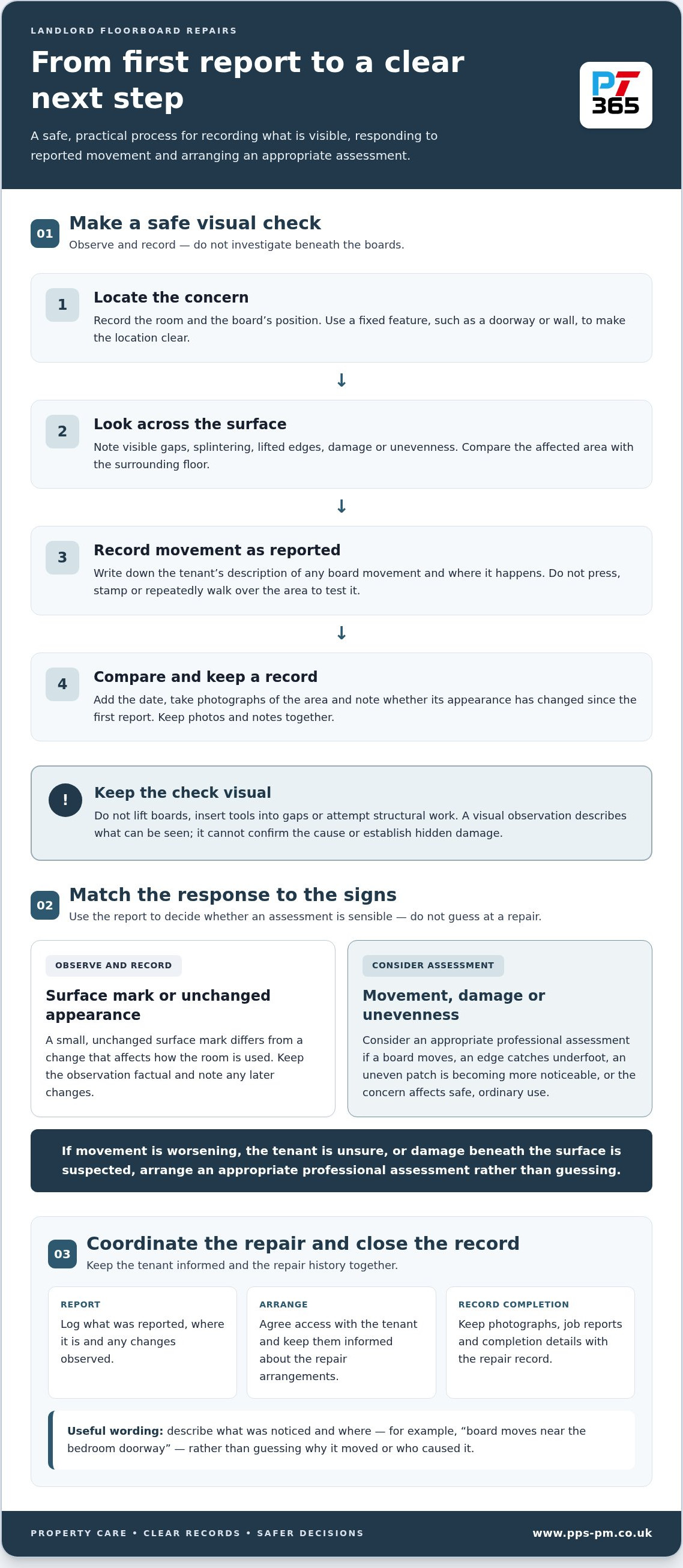
How landlords can organise floorboard repairs and keep tenants informed
A clear process keeps a reported floorboard concern moving from first notification to completed work. It also helps tenants know what will happen next and gives landlords a reliable record of decisions. Keep each step factual, and update the tenant if an assessment changes the proposed response.
Log the report. Record when it came in, the affected room, the tenant’s description and any photographs they provide.
Review the observations. Note whether the report describes surface wear, movement, damage or a change affecting ordinary use. Keep observations separate from assumptions about the cause.
Arrange an assessment. Share the location and reported symptoms with the person organising the visit so they have a clear starting point.
Agree the work. Confirm the proposed scope and access arrangements before work is scheduled. Any additional work must be agreed before it proceeds, except in a genuine emergency to prevent further damage.
Record completion. File the work details, job report and any follow-up action with the original report.
Agreeing access, scope and updates
Contact the tenant before arranging a visit. Agree a practical access time, explain which room or area needs to be reached, and clarify any arrangements needed for entry. The tenant should know whether the visit is for assessment or agreed repair work. If access can’t be gained, an abortive-visit charge may apply.
Pass on the known observations and agreed scope to the person arranging the repair. If an assessment points to a different next step, tell the tenant what has changed and what happens next. Clear updates reduce uncertainty and help avoid disruption caused by mismatched expectations. For further guidance on landlord access for repairs, consider how notice and agreed arrangements fit the visit.
Keeping a useful repair record
Keep the report and its history together. A useful file can include the original tenant message, dated photographs, the assessment findings, the agreed scope, access arrangements and a note confirming completion. Add follow-up observations if the work needs another visit, and record what action was agreed. This creates a straightforward timeline without turning a visual observation into a technical conclusion.
Job reports with photographs can help landlords and letting agents track what was observed and what work was recorded as complete. They’re also useful when managing several repair requests, as each record can be tied to the right property and room. A consistent log supports clearer property repairs for landlords, from the first report through to close-out.
For a practical approach to coordinating reports and next steps, read this guide to managing landlord repairs. If you’re organising a floorboard repair, contact PlumbTech365 Property Services about landlord property repairs.
Getting landlord floorboard repairs organised with PlumbTech365 Property Services
Once you’ve recorded the visible concern, the next step is organising a clear route from report to repair. PlumbTech365 Property Services provides property maintenance, carpentry, handyman services and property repairs for landlords and letting agents. The team has over 30 years of experience supporting property maintenance work, helping landlords manage repair requests with clear communication and useful job records.
Property maintenance support for landlords and agents
Flooring concerns can sit alongside other maintenance requests, so a consistent way to track each job can make coordination easier. Dedicated account management gives landlords and letting agents a point of contact for managing repair requests. Job reports with photographs help show what was observed and record the work completed, supporting a clear history for each property.
This is practical support for landlords overseeing more than one home or agents handling reports on behalf of clients. Keep the tenant’s description, the assessment and any agreed work linked to the same repair record. If the findings change the proposed scope, communicate that before further work is arranged. Additional work must be agreed before it proceeds, except in a genuine emergency to prevent further damage.
For a wider view of organising repairs and ongoing maintenance, the professional property maintenance guide offers related guidance. PlumbTech365 Property Services is 100% Gas Safe Registered and has £5 million public liability insurance.
Practical next steps for arranging a repair
When making an enquiry, describe the visible issue in straightforward terms. Include the affected room, the location of the board and whether you’ve noticed a change. Relevant photographs can help explain the concern, but they should be treated as a record of what’s visible, not a diagnosis of hidden damage. If a tenant has reported movement or difficulty using the area, include that observation too.
To discuss property repairs for landlords, call 01322 252015 or email info@plumbtech365.co.uk. You can also call 01322 251520. Sharing a concise description and any useful photographs helps make the initial conversation more focused. Keep the tenant informed about the agreed next step and access arrangements, then retain the job report with the repair record.
If you’re ready to organise property maintenance or carpentry support, contact PlumbTech365 Property Services about landlord repairs to discuss the issue and the information you’ve gathered.
Take the next step towards a well-maintained rental home
A floorboard report is also a chance to make future maintenance easier. Once the issue has been dealt with, use what you’ve learned to spot recurring patterns across your property portfolio. Similar reports in the same area or room may help you decide what to keep an eye on during routine checks, without assuming that one repair explains another. When maintenance extends into wider interior touch-ups or redecorating, firms like Colorado Springs Painters highlight how professional property improvement services can help restore living spaces to a high standard.
Keep the next step practical: respond to new concerns, record changes and make sure tenants know how to report anything that affects their use of the property. A calm, consistent approach helps prevent uncertainty from building and gives you a clearer basis for planning property repairs for landlords.
If you’d like support organising property maintenance, contact PlumbTech365 Property Services to discuss your requirements. With a clear report and a sensible next step, you can move forward with confidence and keep your rental home in good order.
Frequently Asked Questions
Can a landlord repair loose floorboards themselves?
Yes, a landlord can carry out a repair if they have the practical skills to do it safely and understand the work involved. Don’t treat a loose board as a simple DIY task if its cause is unclear, it moves underfoot or nearby boards are affected. Avoid lifting boards to investigate or attempting structural work. If you’re unsure about the floor’s condition or the repair, arrange a professional assessment first.
How can I tell whether floorboards need repair or simply show normal wear?
Surface fading, light scuffs or worn finish may be cosmetic, particularly if the floor remains even and the boards don’t move. A raised edge, splinter, widening gap or section that shifts underfoot deserves closer attention, especially if it affects ordinary use. Compare the area with nearby boards and check whether the appearance changes. These signs help guide the next step, but they can’t confirm the cause or condition beneath the floor.
Should tenants report a damaged floorboard to their landlord?
Yes. Tenants should tell their landlord or letting agent about damage, movement or a change in the floor, rather than trying to repair it themselves. A useful report states which room is affected, where the board is and what the tenant noticed. For example, they can explain that a board near the doorway has started moving. If the area seems unsafe to walk on, they should make that clear in the report.
What should a landlord record when arranging floorboard repairs?
Keep a dated record of the tenant’s first report, the precise location, and what they observed. Save relevant photographs with a short caption, such as “bedroom, beside wardrobe, edge lifted”. Add notes from the assessment, the agreed scope of work, access arrangements and the completion date. If further action is recommended, record who will follow up and what was agreed. Clear entries make it easier to understand the job’s history later.
Can a contractor lift floorboards to inspect what is underneath?
A contractor may need to open the floor if an assessment indicates that a visual check can’t clarify the concern, but lifting boards shouldn’t be assumed as the first step. Agree the proposed inspection and any related work scope before it proceeds. Tell the tenant which area may be affected and arrange suitable access. A contractor’s findings can guide repair planning, but the appropriate approach depends on the floor and the issue observed.
What happens if a tenant cannot provide access for a repair visit?
Contact the tenant promptly to understand the access problem and agree another practical arrangement. Tell the person organising the work, then confirm the revised date and access details with everyone involved. If access cannot be gained, an abortive visit may be charged at the applicable call-out rate. Keep a note of the missed appointment and the follow-up agreed, so the repair request doesn’t stall or become confused with another job.
How can landlords reduce delays when arranging floorboard repairs?
Send a complete report at the outset, with the affected room, exact location, tenant observations and any useful photographs. Clarify whether the visit is for assessment or agreed work, then settle access arrangements before confirming it. Reply promptly if the assessment changes the proposed scope. For property repairs for landlords, one organised record per job helps keep decisions, updates and follow-up together, reducing avoidable back-and-forth between the tenant, agent and person arranging the work.


Comments