


Capital Expenditure on Property Repairs and Tax Treatment
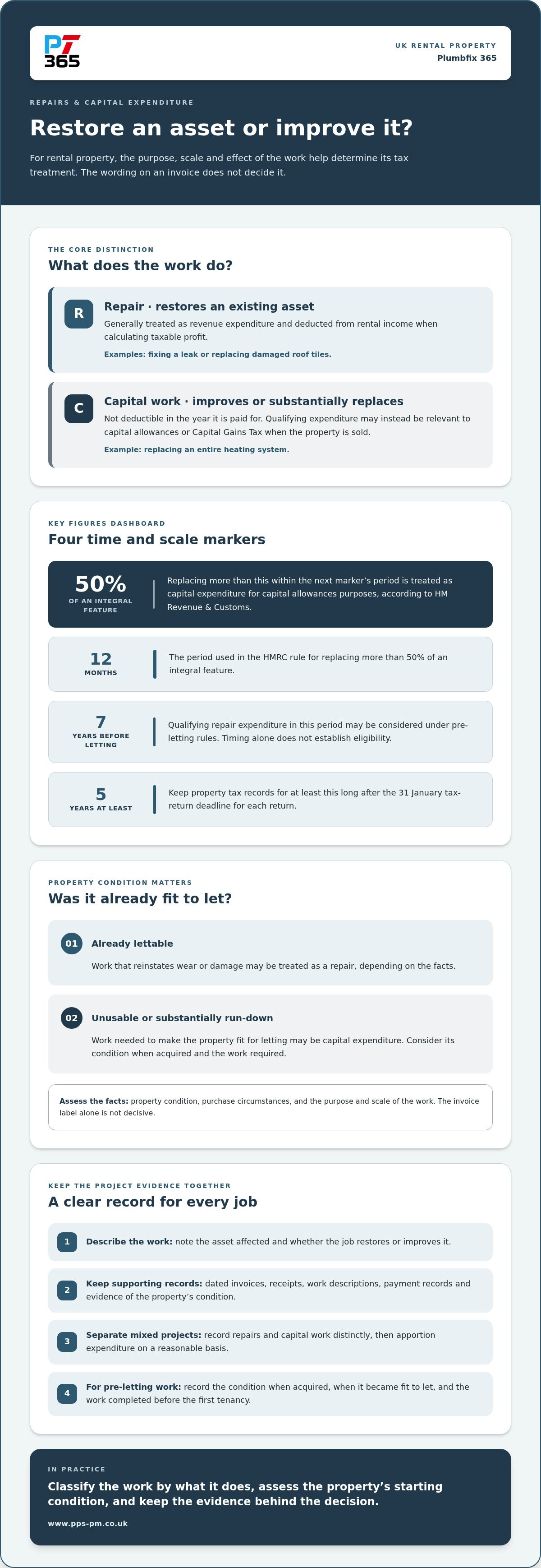
For UK rental property, repairs that restore an existing asset are generally treated as revenue expenditure, while work that improves or substantially replaces it is usually capital expenditure. Knowing how to manage capital expenditure for property repairs starts with separating those categories: repairs may be deducted from rental income when calculating taxable profit, but improvements aren’t deductible in the year you pay for them and may instead affect Capital Gains Tax when the property is sold.
It’s understandable to assume that any work needed to put a property back into good order counts as a repair. But the property’s condition when acquired, whether it was fit to let, and the scale and effect of the work can all affect its tax treatment. The label on an invoice does not decide the matter.
This guide explains how to distinguish repairs from capital improvements, how the rules apply to run-down or newly acquired properties, and how planned spending can help protect property value. It also covers the records and maintenance planning that help when arranging work and assessing its tax treatment.
Table of Contents
Tax treatment of capital expenditure on UK rental property
For landlords, the distinction affects when spending can reduce taxable rental profit. Repairs and maintenance are generally deducted from rental income when calculating profit. Capital improvements are not allowable expenses in the year they are incurred, although qualifying expenditure may be relevant to capital allowances or the Capital Gains Tax calculation when the property is sold.
A repair usually restores an existing asset, such as fixing a leak or replacing damaged roof tiles. An improvement changes or substantially upgrades the asset, such as replacing an entire heating system. The work’s purpose, scale and effect matter more than the invoice label. If a project combines repairs and capital work, keep separate records and apportion the expenditure on a reasonable basis.
Properties bought in a derelict or run-down state need careful assessment. Work to make a property fit to let can be capital expenditure if it could not be let when purchased. A repair to a property that was already lettable may instead be treated as revenue expenditure. The property’s condition, the purchase circumstances and the work required all help determine the treatment.
Can property repair and improvement costs be claimed as capital allowances in the UK? Some capital expenditure on property may qualify for capital allowances, but not every repair or improvement does. For UK capital allowances purposes, replacing more than 50% of an integral feature within 12 months is treated as capital expenditure, according to HM Revenue & Customs.
Do UK building regulations or planning permission apply to major property repairs? They can, depending on the work and property. Tax treatment is a separate question: calling work a repair does not determine whether planning permission or building regulations apply.
How much should landlords reserve for property repairs and capital expenditure? Set a reserve based on the property’s condition, maintenance history and expected replacement needs. Review it when inspections identify new work, and keep planned capital projects separate from routine repairs.
What records and invoices should be kept for property repair expenditure? Keep dated invoices, receipts, work descriptions, payment records and evidence showing the property’s condition and the purpose of each job. Property tax records must be kept for at least 5 years after the 31 January tax return deadline for each tax return.
A practical way to manage capital expenditure for property repairs is to record each job separately, noting the asset affected and whether the work restores or improves it. For a heating project, a clear written scope documents what changed. Keep the technical explanation with the project records.
Expenditure on dilapidated properties before letting
A property’s condition at purchase can affect how pre-letting work is treated for tax. If a house is so run-down that it cannot be used or let until substantial work is completed, the work needed to make it fit for letting may be capital expenditure. The purchase price and condition provide useful context: a marked reduction reflecting serious defects can support the view that the property was acquired in a dilapidated state.
That does not mean every job carried out soon after purchase is capital. Repairs that reinstate wear or damage can be revenue expenditure, including when the property was bought shortly before the work. If the property was already lettable, repairs may be treated as revenue expenditure. Replacing single-glazed windows with double glazing, or lead pipes with copper or plastic pipes, are examples of repairs. The key distinction is whether the work restores an asset or makes an unusable property fit to let.
Keep the evidence together before calculating rental profits. Record the property’s condition when acquired, the date it became fit to let, and the work completed before the first tenancy. Match each invoice to a clear description, such as repairing a leak, replacing damaged fittings or undertaking extensive work to make rooms usable. Separate improvements from repairs when a project includes both, and apportion the amounts on a reasonable basis.
Some qualifying repairs before the letting business starts may still be allowable. HM Revenue & Customs guidance allows qualifying repair expenditure incurred in the seven years before a property letting business starts to be considered under the pre-letting rules. The timing alone does not establish eligibility: the nature of the work and its connection to the rental business matter.
Lease obligations create a separate question. In one UK example, a tenant took a property in poor repair under a lease lasting 21 years and agreed to refurbish it under the lease. At the end of a lease, payments for dilapidations are normally deductible when the tenant received the property in good repair. The starting condition and the lease terms help explain what the payment relates to.
For landlords, classify each job on its facts, not simply by its timing or invoice wording. A repair that restores a lettable property may affect rental profits differently from work that turns an unusable building into a rental asset. Keep scopes, condition notes and invoices together so the records show why each job was carried out and how it relates to the letting business.
Protecting property value through planned capital expenditure
A property plan should identify major repairs, upgrades, refurbishments, extensions and replacement of key building elements. Start with the building’s current condition, then record which work protects its structure, keeps essential systems operating or improves its usefulness. This turns separate jobs into a clear programme rather than a series of unexpected decisions.
What are the risks of delaying essential property repairs? A small defect, such as a roof leak, can allow water to damage ceilings or internal finishes if left unattended. Deferred maintenance can become an emergency, requiring more work than a planned repair. Delays can also disrupt tenants and affect the property’s condition.
Use a condition assessment to rank work by urgency and consequence. A surveyor’s report can describe visible defects, risks and recommended further investigation. For example, evidence of water ingress near a roof should prompt an assessment of the roof and affected rooms. Record the finding, proposed work, priority and reason for scheduling it.
Forecast major building systems before a failure becomes urgent. Note the condition and maintenance history of heating, electrical and water systems, then identify which need routine attention and which may require substantial repair or replacement. A schedule of regular checks, repairs and servicing helps owners plan ahead and maintain critical systems.
Build the capital plan around the property’s expected needs and available resources. Group related projects where practical, set a sequence, and review the plan when inspections uncover new defects. For example, coordinate work to address a leak with repairs to the damp-affected area. Keep planned upgrades separate from routine maintenance in your records.
Choose improvements for their purpose, not just their appearance. Upgrading a property may improve its appeal to tenants or buyers, while replacing an asset to restore its original condition may be a repair. Capital improvements are not deducted from rental income in the year incurred; they may instead be relevant to capital gains when the property is sold.
For Capital Gains Tax, keep evidence of improvement work and its lasting effect. Enhancement expenditure must still be reflected in the property’s state or nature at the time of disposal. Keep scopes, invoices, reports and completion records together. These documents help explain what changed, why the work was done and how it affected the asset.
Review the plan after each project is completed. Compare the final work with the original scope, update condition notes and record any new maintenance needs. This gives landlords and property managers a useful history for future buying, upgrading and budgeting decisions. Effective planning connects property condition, work priorities and tax records without treating every project as the same kind of expenditure.
What counts as capital expenditure versus a repair for UK property tax purposes?
A repair generally restores an existing asset to working order without changing its essential character. Replacing broken roof tiles or repairing a leaking pipe are examples. Capital expenditure includes work that improves or changes the property, or substantially replaces an asset. The deciding factor is the purpose and nature of the work, not simply whether the property looks better afterwards.
Compare the result with the property’s condition before work began. Replacing an outdated item with its nearest modern equivalent can still be a repair, even if newer materials perform better. Technological advances alone do not necessarily make the work capital, provided the asset’s functionality and character remain broadly the same. Replacing single glazing with double glazing is an example of a change that may still count as revenue expenditure.
Kitchen work depends on what is replaced and what is added. Replacing worktops and wall units, retiling, plastering and rewiring may be repairs when the new kitchen is broadly similar to the old one. Adding new features or fitting superior-quality materials and appliances points towards improvement. Record the original fittings, replacements and additions so the project can be assessed by its separate elements.
Scale can change the tax analysis. In G Pratt & Sons v HMRC, the First-tier Tribunal decided in 2011 that resurfacing and adding kerbing to a 239-metre farm drive was a repair, not an improvement. By contrast, Auckland Gas Co Ltd v IR Commrs [2000] BTC 249 treated polyethylene piping inserted into an existing gas-pipe system as capital expenditure because it substantially changed the system’s character. These examples show why the work’s overall effect matters.
For a project involving both repairs and upgrades, divide the work into clear components. A written scope can identify which items restore existing parts and which add functions or materially alter the asset. Allocate shared work on a reasonable basis and keep a record of the explanation. This is more useful than relying on one broad invoice description such as “refurbishment”.
Market value is not the sole test. The tax assessment focuses on the purpose of the expenditure, not whether the property’s value actually rises. Consider what the work was intended to achieve: restoring an existing asset or enhancing it. A new finish may improve appearance without changing the underlying asset, while a major alteration may be capital even if its resale effect is uncertain.
Keep a short decision record for each disputed item: describe the original condition, the work carried out, the replacement standard and any change in function. For borderline cases, HMRC’s property income guidance, PIM2025, or a property tax adviser can help landlords apply the distinction to their evidence.
What are the HMRC rules for repairs and improvements to a property?
HMRC distinguishes revenue expenditure from capital expenditure by considering the work’s purpose and effect. Revenue costs for a rental business can generally be deducted in the tax year incurred. Capital improvements are not deducted as rental expenses in that year; relief may instead arise when the property is sold. Classify each part separately when a project includes different types of work.
A repair restores an existing asset, while an improvement enhances or changes it. Replacing old building materials with broadly equivalent modern materials normally remains revenue expenditure when any improvement results only from the newer materials. A more durable replacement does not automatically change the tax treatment. The question is whether the work has materially changed the asset’s character or function.
Consider the difference between a roof repair and a substantial upgrade. Replacing a roof can be a repair, while rebuilding a property is capital expenditure. Likewise, replacing an entire central heating system is treated as capital expenditure. The extent of the replacement and the system’s continuing function help explain whether the work restores an asset or replaces it.
Kitchen projects need to be assessed component by component. Replacing existing units with broadly similar units may be a repair, while adding features or choosing superior materials and appliances can indicate an improvement. Keep the original scope, revised specifications and invoices together. If one contract covers repairs and enhancements, apportion the work reasonably and record the basis used.
Technological change does not automatically make replacement work capital. Replacing single glazing with double glazing may qualify as revenue expenditure when it reflects technological progress and the property’s function remains broadly the same. By contrast, inserting polyethylene piping into an existing gas-pipe system was treated as capital in Auckland Gas Co Ltd v IR Commrs [2000] BTC 249, because the system’s character changed substantially.
Keep tax relief separate from building-control requirements. HMRC’s repair-versus-improvement test addresses tax treatment; it does not decide whether planning permission or building regulations apply. The work itself determines those requirements. Record the project’s technical scope and any relevant approvals instead of assuming its tax classification answers a separate compliance question.
For each job, retain a dated description of the defect, the asset affected, the completed work and the replacement standard. Then note whether the work restores, upgrades or replaces the asset, and clearly allocate any mixed work. These records support the assessment when calculating rental profits or a later capital gain.
We are a trusted property Maintenance company providing reliable, high-quality services across London and Kent: Boiler Installation
Keep the project scope and invoices clear so you can record what was installed and distinguish replacement work from repairs.
For landlords, letting agents and property managers, planned boiler work can sit within a wider property maintenance programme. Boiler servicing can also help track the system’s condition and maintenance needs. Carpenters can support related property work where needed.
For help with boiler installation or property maintenance, contact We are a trusted property Maintenance company providing reliable, high-quality services across London and Kent.
Make your next property decision with confidence
Turn the distinction between repairs and improvements into a practical process for your property. Before commissioning work, write down the problem, intended outcome and parts of the building affected. This gives your accountant, property manager and contractors a shared reference point and helps keep tax records aligned with the work completed.
A practical way to manage capital expenditure for property repairs is to link each planned job to your property’s maintenance calendar. Set a review date after completion, note any follow-up work and update the plan as the property’s needs change. This creates a clearer basis for future decisions, whether you’re maintaining a rental home or planning a larger upgrade.
If you need help with property maintenance or boiler installation, We are a trusted property Maintenance company providing reliable, high-quality services across London and Kent. about your property maintenance needs. A clear project scope is a useful first step towards work that supports your property’s ongoing condition. Move forward with a plan that keeps the building’s needs and the tax records in view.
Frequently Asked Questions
What counts as a ‘repair’?
A repair fixes damage or wear so an existing part of the property continues to serve its original purpose. For example, repairing a broken window or repainting a marked wall can be a repair. The scale and purpose matter: restoring a damaged item differs from adding a new feature or changing how the property is used. Note the defect and completed work to support your classification.
Can landlords deduct property repair costs from rental income in the UK?
Generally, landlords can deduct allowable repair and maintenance expenses when calculating taxable rental profit. For example, repairing a leaking pipe or repainting between tenancies may qualify if the work restores the property rather than improving it. Record the invoice and link it to the relevant property and job. If the project also includes an upgrade, separate that element from the repair before calculating the allowable expense.
How should property owners budget and prioritise major repairs and capital works?
Start with a condition review, then rank projects by risk, urgency and likely effect on the building. A recurring roof leak, for instance, may need attention before a cosmetic upgrade because water ingress can damage other areas. Record expected system replacements, routine servicing and planned improvements in separate categories. Review the plan after inspections or completed work, and adjust priorities when new defects or evidence change the property’s needs.
How do repair costs compare with replacement or improvement costs for tax purposes?
A repair usually restores an existing asset, while replacing an entire asset or making a substantial upgrade is generally capital expenditure. Fixing a broken boiler is an example of a repair; replacing the entire central heating system is treated as capital expenditure. A modern equivalent may still count as a repair if its function and character remain broadly similar. Describe the original item, the work undertaken and any change in function.


Comments