


Choosing a Commercial Property Maintenance Company
A maintenance issue can disrupt staff, tenants and day-to-day operations if it is left unattended. We are a trusted property Maintenance company providing reliable, high-quality services across London and Kent, and as your chosen commercial property maintenance company, we can coordinate planned upkeep and repairs, including plumbing and heating work, emergency support and compliance-related tasks. Service coverage depends on the provider and the property’s location.
It is reasonable to expect a clear picture of what is covered and where help is available before arranging maintenance. This guide explains the main types of commercial property maintenance, how to understand service coverage across the UK, and how emergency and compliance support can help you manage building needs. It also outlines practical points to consider when choosing a maintenance service, so you can make the next decision with greater confidence.
Table of Contents
What does commercial building maintenance cover?
Commercial maintenance includes planned upkeep and repairs that keep a building usable. A commercial property maintenance company can coordinate routine jobs, handyman work and trade-specific repairs to suit a property’s needs.
Start by listing each building, its facilities and recurring issues. Then group work into scheduled checks, planned repairs and urgent faults. This makes it easier to identify what needs attention and arrange access around staff, tenants and business activity across the UK.
Handyman services
Handyman services address practical, smaller jobs that can affect daily use: repairing a door that will not close, replacing a damaged fixture or completing minor carpentry. Small property maintenance fixes might take under an hour, depending on the task. Record the room, fault and access details so the work can be assessed efficiently.
Check that the agreed scope distinguishes minor repairs from work requiring a specialist trade. A loose door handle and a damaged door frame, for example, may need different skills. For decorating, specify the surfaces, preparation and finish required.
Landlord and property manager services
Landlords and property managers can use maintenance services to organise reported faults, arrange access and track completed repairs. For rented property, landlords are generally responsible for repairs to the structure, heating, water and electrics. Log each report with its location, description and date, then record the action taken.
For a portfolio, group jobs by property and urgency rather than handling each report in isolation. A leaking tap in one flat and a damaged communal door need separate records, access plans and follow-up. Clear records help property managers coordinate tenants, trades and building staff.
Building repairs and trade services
Building repairs may involve carpentry, plastering, painting and decorating, plumbing or heating. The right trade depends on the fault: damaged plaster needs different work from a boiler problem. Describe the visible issue and its effect on the building before arranging a repair.
Separate repairs from improvement work in the maintenance plan. Fixing a damaged cupboard door is a repair; replacing several units is a wider project. This distinction helps managers set priorities, coordinate trades and identify any follow-on work.
Service coverage depends on the provider, the property location and the work required. Provide the building’s postcode, type of premises and task when arranging maintenance. A schedule can distinguish recurring work, such as inspecting shared areas, from one-off repairs. For properties in multiple locations, keep a separate maintenance record for each site.
Out-of-hours work needs a practical access and escalation plan, especially when a fault could affect how the building is used. Set out who reports the issue, who can authorise access and how staff or tenants will be informed. For a heating fault outside normal opening hours, record the response and any follow-up repairs.
Emergency call-outs
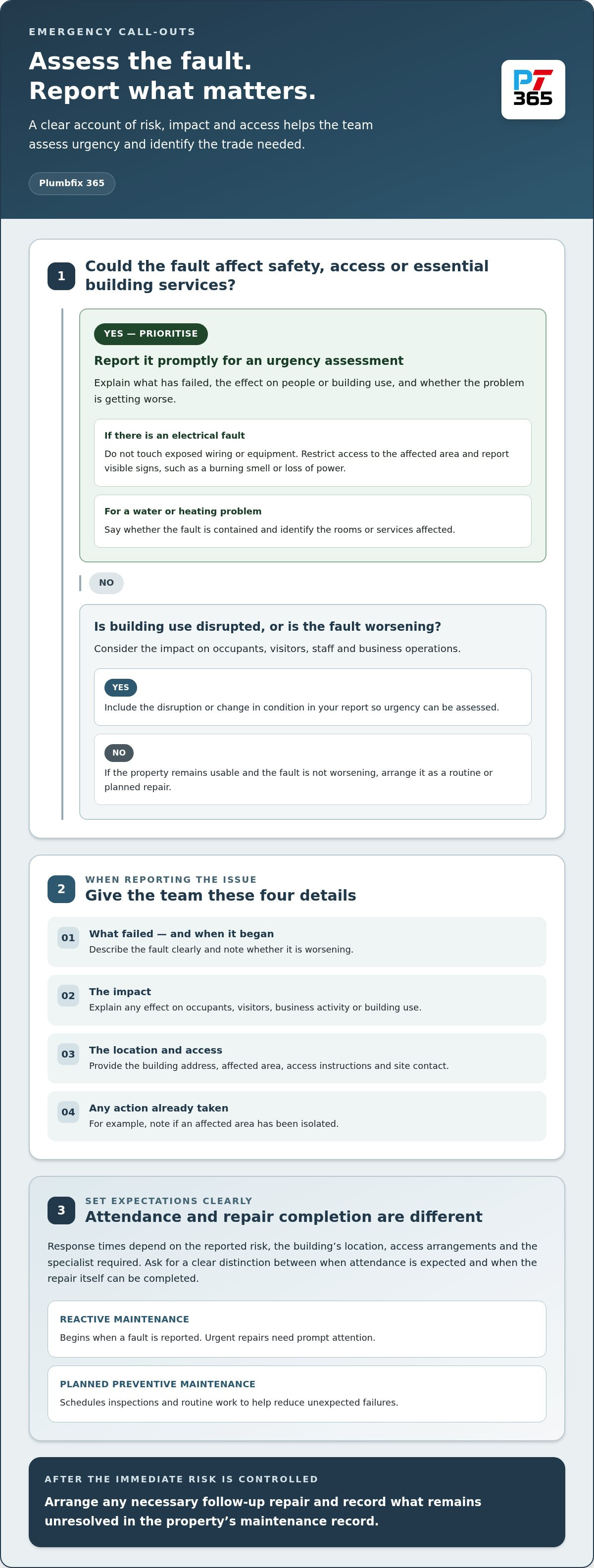
Act promptly when a fault threatens safety, access or essential building services. A clear report helps identify its urgency and the trade needed.
Reactive maintenance response
Reactive maintenance begins when a fault is reported; urgent repairs need prompt attention. Planned preventive maintenance instead schedules inspections and routine work to help reduce unexpected failures. A heating fault during cold weather may need urgent assessment, while a routine adjustment can be scheduled.
When arranging work, provide the building address, access instructions, affected area and a concise description. Explain whether the fault is worsening or disrupting building use. This information helps the team assess the job and identify whether plumbing, heating or another specialist trade is needed.
Emergency maintenance response times
Response times depend on the reported risk, the building’s location, access arrangements and the specialist required. A leak affecting occupied rooms needs different prioritisation from a minor fault that leaves the property usable. Ask for a clear distinction between when attendance is expected and when the repair itself can be completed.
For an urgent report, prepare these details:
State what has failed and when it began.
Describe any immediate impact on occupants, visitors or business operations.
Provide safe access details and the name of the site contact.
Note any steps already taken, such as isolating an affected area.
Act promptly on urgent property repair issues. If there is an electrical fault, avoid touching exposed wiring or equipment and restrict access to the affected area. Report visible signs, such as a burning smell or loss of power, rather than attempting a repair. For water or heating problems, explain whether the fault is contained and which rooms or services are affected.
Understand out-of-hours arrangements before an incident occurs. Record who can report an emergency, who can authorise access and how occupants will be updated. For example, a building manager may need to meet a specialist at a locked plant room or give entry instructions to security staff. Keep the fault and follow-up work in the property’s maintenance record.
Once the immediate risk is controlled, arrange any necessary follow-up repair and record what remains unresolved. For plumbing or heating problems, provide the property location and describe the work needed when arranging maintenance.
Health, safety and compliance support
Compliance support helps property managers organise inspections, record findings and assign follow-up work. Start with an asset list covering fire precautions, air conditioning and visible building defects.
Fire safety and statutory compliance
Fire risk assessments for London commercial properties are regulated under the Fire Safety Order 2005, according to the UK legislation register. Keep the assessment with the property’s safety records, alongside actions arising from its findings. For example, a blocked fire exit or damaged door should be logged, assigned and followed through.
Air conditioning inspections are required for London commercial property systems above 12 kW, according to the UK legislation register. Record the system’s capacity and inspection history so the relevant checks can be planned. A dedicated schedule helps a property manager track due work across several buildings without relying on memory.
For each inspection, record the date, location, findings and corrective action. If work requires a specialist, keep the instruction and completion record together. This creates a clear audit trail and helps the building team distinguish open actions from completed work.
Health and safety compliance
Health and safety support can include identifying hazards in shared areas, documenting defects and coordinating repairs. A loose handrail, damaged floor covering or poorly lit corridor gives staff a specific issue to report and resolve. Record the exact location and who is responsible for follow-up.
Use a consistent process: report the concern, assess its immediate effect, assign the right trade and record the outcome. During refurbishment, update the maintenance records if layouts, access routes or building systems change. Clear records help managers brief trades and building users on relevant site conditions.
Record visible signs that may need further structural assessment, such as cracks, water ingress, loose external materials or doors that no longer close properly. Note where the defect appears and whether it changes over time. A maintenance record cannot replace a specialist survey, but it helps identify what needs closer examination.
Before arranging work, gather the property address, affected area, inspection notes and access details. Then separate urgent hazards from planned improvements, such as repainting during a refurbishment. This gives the responsible manager a practical order of work and helps a contractor understand the task before attending.
For buildings with multiple systems, group checks by asset and location. Keep fire-related actions, air conditioning inspection records and structural observations easy to retrieve. Review open items at regular property meetings, assign an owner to each action and record completion evidence. That simple routine helps prevent important findings from disappearing between inspections.
London commercial building maintenance company directory
A directory can help identify firms by location, building type and trade coverage. Use its entries as a shortlist, then compare the work each company describes.
To choose a commercial property maintenance company, start with the work required and the building’s location. Check that the company’s service coverage and listed trades match your needs, then compare its proposed scope and arrangements.
Building fabric, lifts, security and BMS
Directory entries may cover building fabric, lifts, security systems or a building management system (BMS). These are distinct areas of work, so check which are directly included and which involve a specialist partner. For example, a damaged external door concerns building fabric, while a faulty lift needs lift-specific support.
Match the proposed service to your building’s actual assets. Record each system, fault and location, then check whether the company covers planned maintenance, repairs or installations for that work. This avoids assuming a general maintenance service includes every technical system.
Repairs and installations
Some firms focus on building repairs; others coordinate multiple trades for a wider job. A directory can help distinguish a single repair, such as damaged plaster, from a project involving carpentry, heating and follow-on decorating. Look for a clear description of the trades covered and how work is organised.
For multi-trade repairs, map the tasks in sequence. A leak may need plumbing attention before damaged finishes are repaired. A written scope should identify the first trade, any follow-on work and who coordinates access at the property.
Choosing a maintenance company
How should you choose a commercial property maintenance company? We are a trusted property Maintenance company providing reliable, high-quality services across London and Kent. Match its stated coverage and services to your building, then assess its experience with the relevant trades, planned work and repairs. Check that its service description fits your needs rather than relying on a broad category.
London directory figures offer context, not a quality ranking. As of October 10, 2026, the directory included 51 companies with 51-200 employees, 9 with 201-500, 7 with 501-1,000, and 5 with 1,001-5,000 employees. The median employee-size band was 11-50 employees, and listings averaged 8.5 contacts per company. These figures describe directory entries, not the suitability of an individual firm.
Comparing local companies and quotes
To compare companies and request quotes, send each the same property details, repair list, access requirements and preferred schedule. Compare the written scope, included trades, planned tasks and exclusions rather than judging proposals by their headline descriptions.
For a building in the capital or surrounding areas, use the same approach with regional directory listings. Shortlist entries that name the relevant location and work type, then compare their proposed steps and coordination arrangements. Ask for a written quote that separates each task, so you can see whether competing proposals cover the same repairs and installations.
Commercial and residential property maintenance in London
Commercial maintenance should reflect the building’s use, location and daily demands. A residential block, office and shop each need a clear plan for routine upkeep, reported faults and follow-up repairs.
A general property check-up, including boiler servicing, roof checks and electrical checks, is advised once a year. Treat this as a planning prompt: record the condition of each area, note issues and schedule relevant follow-up work. A check-up helps owners and managers identify maintenance priorities before they become larger projects.
Commercial property maintenance often needs to be arranged around staff, customers and opening hours. A repair in a shared reception area may need to avoid busy periods, while a heating fault could affect the whole workplace. Include access arrangements, affected areas and operational impact when reporting each job.
Residential maintenance has different coordination needs. In a block of flats, a fault in a shared corridor differs from a repair inside an individual home. Keep the building address, flat or communal-area location, contact arrangements and repair history together. This helps landlords and managing agents track reports across properties without confusing one job with another.
Plumbing reports are easier to assess when they name the affected fixture and room. A dripping kitchen tap, for example, differs from a leak affecting a ceiling below. Include when the issue began and whether it is worsening. For heating faults, note which areas are affected and whether the problem concerns one radiator or the whole property.
For a London portfolio, organise a simple maintenance register by property and job type. Separate scheduled work from reactive repairs, and mark each task as reported, arranged or completed. Add inspection notes, contractor details and any follow-up required. This gives a property manager a practical view of outstanding work across residential and commercial sites.
Before commissioning a repair, define the requested work in writing. Include the visible fault, location, access needs and expected outcome. If the proposal includes a workmanship guarantee, record what it covers and any stated conditions. A clear scope makes it easier to compare completed work with the original request.
For planned maintenance, group compatible tasks at the same property. A roof check and a reported ceiling stain, for example, may need to be considered together. Keep urgent faults separate from routine improvements, then assign each task to the appropriate trade. This creates a useful work order without delaying issues that need prompt attention.
Use a consistent log across sites, even when their needs differ. Start with the property, record the issue, assign the next action and close the record when work is complete. To discuss property maintenance needs across London and Kent, contact the maintenance team.
We are a trusted property Maintenance company providing reliable, high-quality services across London and Kent: Boiler Installation
Plumbfix 365 is a practical next step for property owners and managers arranging boiler installation or servicing. These services can support planned heating work, while property maintenance can address building tasks such as carpentry.
For a boiler installation, share the property details and heating requirements. For servicing, describe the boiler concern or work needed. Clear information helps define the job and coordinate any related property maintenance.
Contact Plumbfix 365 to discuss boiler installation, servicing or property maintenance for your building.
Set a clear plan for your next maintenance decision
Turn your building records into a practical maintenance plan. Identify which work needs attention first, who can approve it and how access will be arranged. A concise brief helps a commercial property maintenance company understand the site and the outcome you need, whether you manage one property or several.
Plumbfix 365 can support property owners and managers with boiler installation and local plumbing needs. Share the property location, the issue or planned work, and any access arrangements. This gives the team a clear starting point for discussing the relevant service.
Choose a next step that fits your building’s immediate needs. If you’re arranging heating work or need local plumbing support, contact our London and Kent maintenance team to discuss the work. A clear brief can help you move from an open maintenance task to a defined plan.
With the right information in hand, you can approach the next repair or project with greater clarity and confidence.
Frequently Asked Questions
What areas of London do you cover?
PlumbTech365 Property Services serves customers nationally, including London. Share the property postcode, building type and work required when making an enquiry. This helps clarify the site and the relevant service, whether you need property maintenance, plumbing or heating support. The company’s work includes planned and reactive property maintenance, boiler installation and servicing, alongside repairs for landlords and letting agents.
What guarantees do you offer for your work?
Workmanship is covered by a 12-month guarantee from completion, covering defects in workmanship. Manufacturer warranties are separate, so keep any product warranty information with your property records. If you’re reviewing completed work, identify the job and completion details, then describe the issue clearly. This helps distinguish a workmanship concern from a product matter covered under a manufacturer’s separate warranty.
Do you provide regular maintenance packages?
Organise regular upkeep through planned property maintenance. Set out work around the building’s needs, such as recurring repairs, carpentry, painting and decorating, or plumbing and heating. Keep an asset list and note which items need routine attention. This gives landlords and management teams a practical basis for scheduling work and tracking completed jobs.
How do building maintenance contracts work?
A maintenance agreement sets out the agreed scope, responsibilities and process for arranging work. It can distinguish planned tasks from reactive jobs and record how access, reporting and approvals are handled. For a building with several occupants, define who can report faults and who authorises work. Keep the agreed scope and job records together so each request can be checked against the arrangement.
Need a hand?
Contact PlumbTech365 Property Services to discuss a maintenance or heating requirement. A useful enquiry includes the property location, the problem or planned task, access details and any relevant job history. For example, mention whether a boiler needs installation or servicing, or whether a landlord needs property repairs. Send an enquiry to the property maintenance team to outline the work.
What services do commercial property maintenance companies provide in the UK?
Service scopes commonly include planned upkeep, handyman tasks, building repairs, carpentry, decorating, plumbing and heating. Some providers also handle boiler installation and servicing, while others focus on particular trades or property types. For a commercial site, list the building systems and recurring faults first. Then match those needs to the company’s stated work, such as a leaking pipe repair or scheduled decorating.
How do commercial property maintenance contracts and pricing work?
A written quotation should describe the work included, so you can compare proposals against the same job scope. Written quotations from PlumbTech365 Property Services are valid for 30 days. Invoices are payable within 14 days of issue, and larger projects use staged payment schedules. Review the written scope and payment terms before approving work, and retain the documents with the property’s maintenance records.
What qualifications, accreditations and insurance should a UK maintenance company have?
Check that qualifications suit the specific work. Liability is limited to the value of the work carried out; nothing limits liability for death or personal injury caused by negligence. For a boiler or gas appliance task, confirm that the assigned engineer’s registration covers that work.

Comments