


End of tenancy decorating services: a practical landlord checklist
Does every scuff or faded patch mean a property needs a full repaint? Not necessarily. The right end of tenancy decorating services should match the property’s condition and handover needs, rather than follow a blanket approach. When time between tenancies is limited, a clear, proportionate scope helps you decide what needs doing before work begins.
This checklist explains how to compare a property with its check-in condition, record visible wear or damage, and choose between local touch-ups and more extensive redecoration. It also covers how to agree the work scope, arrange access and review completion for a clear handover.
We are a trusted property Maintenance company providing reliable, high-quality services across London and Kent. We provide painting and decorating as part of void works and property refurbishments. Dedicated account management and job reports with photographs help landlords and letting agents organise property work and keep a record of completion. The company is 100% Gas Safe Registered and holds £5 million public liability insurance. Use the steps below to plan the work and keep the handover process straightforward.
Table of Contents
End-of-tenancy decorating services: assess the property before choosing work
A tenancy is ending, the next handover is approaching, and marks on the walls need attention. Don’t start by assuming that everything needs repainting. Record the visible condition first, then use those observations to define proportionate end of tenancy decorating services. A consistent inspection helps you distinguish an isolated mark from deterioration affecting several surfaces or rooms.
Routine wear, isolated marks and apparent damage are useful descriptions, but they don’t establish responsibility on their own. The property’s starting condition and tenancy records provide context. Document what you can see before deciding what work the handover requires.
For general background on the relationship between landlords and tenants, see Landlord and tenant law. An inspection is a practical record of condition, not a decision about a deposit or dispute.
Keep the assessment focused and consistent from room to room.
What should a landlord or agent inspect before redecoration?
Check walls, ceilings, woodwork and other visible finishes in each room. Look for scuffs, holes, cracks, stains and peeling finishes. Take dated photographs in clear light, then compare your observations with available check-in records. Record what you see without deciding whether a tenant or landlord is responsible.
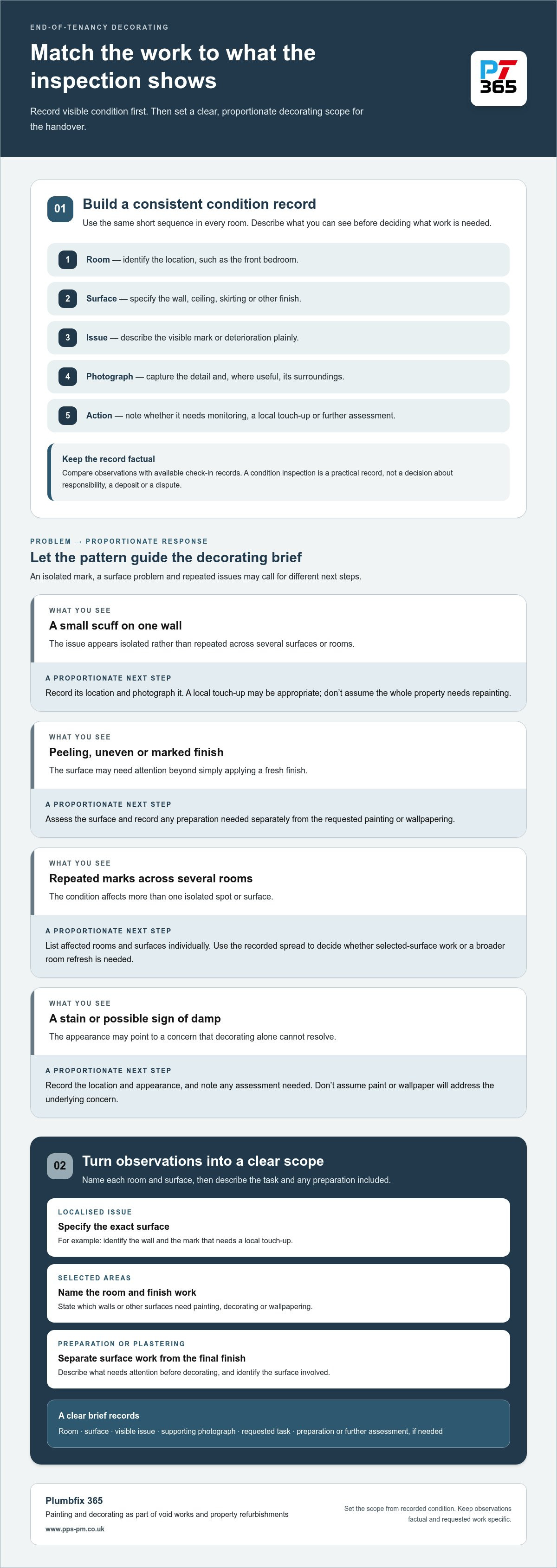
Use the same short sequence for each observation:
Room: identify the location, such as the front bedroom.
Surface: specify the wall, ceiling, skirting or other finish.
Issue: describe the visible mark or deterioration plainly.
Photograph: capture the detail and, where useful, its surroundings.
Action: note whether the surface needs monitoring, a local touch-up or further assessment.
How does property condition affect the decorating brief?
A small scuff on one wall may call for a different response from peeling paint or repeated marks across several rooms. Note whether each issue is localised, repeated on one surface or visible throughout the property. A broad repaint shouldn’t be assumed simply because a tenancy has ended.
Set the decorating scope from the recorded condition: identify the affected rooms and surfaces, the type and spread of each issue, the supporting photographs and the action needed. This gives the handover team a specific brief and keeps the requested work aligned with observed needs. If the records reveal uncertainty, note it rather than presenting an assumption as fact.
PlumbTech365 Property Services provides painting and decorating as part of void works and property refurbishments. The company is 100% Gas Safe Registered and holds £5 million public liability insurance.
What can end-of-tenancy decorating services include?
Between occupants, decorating should respond to the property’s recorded condition and the work needed for the next handover. It can range from painting selected surfaces to a broader room refresh, with wallpapering or plastering included where the agreed brief calls for it. The term “void works” doesn’t mean every room needs the same treatment. Specify what’s included before work starts.
A useful brief names the rooms and surfaces, describes the finish work requested and separates preparation from the visible decorating task. For example, “paint bedroom walls” is less precise than identifying which walls need attention and whether surface preparation is included. That clarity helps keep expectations aligned.
Which decorating tasks may belong in a void-works brief?
Internal painting and decorating are core parts of a void-works brief. Wallpapering may suit selected walls, while plastering can address surfaces that need attention before decorating. Tie each task to a room and surface, rather than using a broad instruction such as “refresh the property”.
Painting: specify the rooms and surfaces to be painted.
Decorating: describe the areas and finish work required.
Wallpapering: identify the wall or walls involved.
Plastering: state which surface needs plastering as part of the agreed work.
Record carpentry and other property maintenance tasks separately, even when they form part of the same void-works plan. This makes it easier to distinguish the decorating scope from other work in the job.
Why does preparation matter before paint or wallpaper?
Assess the surface before choosing or applying a finish. A marked, uneven or peeling area may need a different approach from a sound surface with a small blemish. Record preparation separately from the visible finish, so the brief explains both what needs doing to the surface and what decorating work is requested afterwards.
Stains or signs that may indicate damp need appropriate assessment before they’re treated as straightforward decorating issues. Note their location and appearance, and don’t assume that paint or wallpaper alone will resolve the underlying concern. Record the observation and any assessment needed without claiming a diagnosis.
Keep the scope practical: list each room, the surfaces involved, the requested decorating task and any preparation or plastering included. This gives landlords and letting agents a clear basis for arranging work without promising a particular finish, turnaround or letting outcome. PlumbTech365 Property Services includes decorating in its void-works planning.
Touch-ups or a full repaint: compare end-of-tenancy decorating options
A full repaint can create a consistent appearance, but it isn’t automatically the right response to every tenancy. Match the work to the spread and condition of the affected surfaces. These planning categories help you compare options; they aren’t fixed packages or specifications. The property assessment and agreed brief determine the scope.
Compare four points: how much of the property is affected, what the surfaces need, how much preparation may be involved and how broadly the work could affect access to rooms. Use the examples as prompts for assessment, then record the property’s actual condition.
When might localised decorating be sufficient?
Isolated marks or a limited surface issue can be a reason to assess a focused repair rather than refresh an entire room. Consider the surrounding finish: differences in colour, age, texture or sheen can affect how visible a touch-up looks. A small repair may not blend seamlessly, so record the expected area of work and review it against the wider surface.
When might more extensive redecoration be appropriate?
Widespread marking or several affected rooms may justify reviewing a broader scope. Repainting selected rooms can create greater consistency across those spaces, while spot repairs limit the work to individual areas. Neither option is automatically preferable. Base the agreed work on the inspection, the condition across rooms and the handover requirements, then define exactly which surfaces are included.
For end of tenancy decorating services, use a simple decision check: are the issues isolated or repeated, confined to one room or spread across several, and likely to need preparation beyond a small touch-up? If the evidence points to a wider refresh, document why. If not, avoid adding rooms without a condition-based reason. Keep the scope proportionate and clear.
End-of-tenancy decorating checklist: organise scope, access and handover
A clear decorating brief helps everyone work from the same record, especially when a tenancy change involves several rooms or property tasks. Follow these steps: assess the condition, define the work, arrange access, then review completion against what was agreed. Keep notes, photographs and decisions together so the handover doesn’t depend on memory or scattered messages.
Inspect and record each affected area. List the room and surface, describe the visible condition and note the decorating work requested. Keep observations factual. Add dated photographs that show the issue clearly and, where useful, the wider area around it.
Set out the decorating scope. Identify the rooms and surfaces included, such as bedroom walls, hallway woodwork or a particular ceiling. Specify whether the brief calls for painting, wallpapering, plastering or preparation work. Avoid broad instructions that leave the work area open to interpretation.
Separate other property tasks. Note any agreed maintenance work separately from decorating. This makes it clear which tasks relate to painting and decorating and which are other property repairs or maintenance.
Agree who can approve changes. Name the person responsible for approving additional work and record how approval will be given. Additional work outside the original quotation must be agreed before it proceeds, except in genuine emergencies to prevent further damage.
Arrange access and contact details. Agree how access will be provided, who will meet or assist the tradesperson, and who can be reached if arrangements change. Make sure the point of contact has the agreed scope and can answer practical questions about the property.
Review the completed work. Compare each room and surface with the agreed brief. Note any outstanding items and retain completion photographs with the job records. A clear record supports a practical handover to the next person managing the property.
What information should the decorating brief record?
Keep the brief usable at a glance. For each item, record the room, surface, observed issue, requested work and supporting photograph. Add preparation requirements where they’re part of the scope, and list other agreed property maintenance tasks separately. Make approval responsibility explicit so changes don’t become informal assumptions.
How can access and handover be organised clearly?
Confirm access arrangements and a practical point of contact before work begins. Abortive visits where access cannot be gained may be charged at the applicable call-out rate. At completion, review the work against the agreed scope and keep the photographs with the job report. PlumbTech365 Property Services provides job reports with photographs to support property maintenance workflows.
For end of tenancy decorating services, a well-organised brief brings scope, access and approval into one clear process. Arrange property decorating and maintenance with PlumbTech365 as part of your void-works planning.
How PlumbTech365 Property Services supports end-of-tenancy decorating
We are a trusted property Maintenance company providing reliable, high-quality services across London and Kent. provides painting and decorating as part of void works and property refurbishments. For landlords and letting agents, this connects decorating with the wider work needed to prepare a property between occupants. The team has over 30 years of experience in property maintenance.
What helps landlords and letting agents coordinate property work?
Dedicated account management gives clients a point of contact for coordinating the brief and keeping communication organised. integrates with property management systems and provides detailed job reports with photographs. These records support property handovers and give landlords and agents a reference for their property records.
Decorating can sit alongside other agreed void works and property maintenance tasks. Keep each workstream clear in the brief, so the rooms and surfaces included in painting and decorating remain distinct from separate repairs or maintenance. A shared record of the agreed scope also gives the people managing the property a practical reference during completion review.
is 100% Gas Safe Registered and holds £5 million public liability insurance. The workmanship guarantee is 12 months from completion, covering defects in workmanship only. It does not cover damage caused by misuse, neglect, or third-party interference.
What should clients know before agreeing the work?
Review the written scope before work begins. Estimates are not fixed prices and may vary; significant variations will be communicated before work proceeds. Additional work not included in the original quotation must be agreed with the client before execution, except in genuine emergencies to prevent further damage. Quotations are valid for 30 days from the date of issue unless otherwise stated.
For clarity, make sure the agreed brief identifies the rooms and surfaces, describes the decorating work and preparation included, and records who can approve changes. Keep access arrangements and the practical contact for the property with the job information. This gives the account manager and the person overseeing the handover the same instructions to refer to.
If you’re planning end of tenancy decorating services, request a free, no-obligation quote based on the property and agreed scope. Contact on 01322 252015 or 01322 251520, or email us directly. You can also arrange property decorating and maintenance as part of your void-works planning.
Make the next property handover easier to manage
Use the decorating brief as part of the property’s ongoing record, not just as a list for the current job. A dated note of the agreed work and completion review can provide a useful reference for future inspections. Keep it with the property’s other handover documents so the next condition assessment starts with a clear record.
For end of tenancy decorating services, turn your inspection notes into a scope that reflects the property’s needs. Set out what should be done, who will approve any changes and how completion will be reviewed. This gives everyone involved a shared point of reference as the property moves between occupants.
When you’re ready to plan the work, discuss your property decorating requirements with PlumbTech365 Property Services. A clear brief is a practical starting point for an organised handover. Get in touch to plan the work.
Frequently Asked Questions
Is a full repaint always necessary at the end of a tenancy?
No. A full repaint isn’t automatically needed. A small mark in one room may call for a different response from deterioration across several rooms. Base the brief on what’s recorded, the surfaces affected and the handover requirements. Compare observations with available property records, and agree the decorating work before it starts. Keep condition notes separate from any decision about a tenancy or deposit dispute.
What do end-of-tenancy decorating services usually cover?
The work depends on the property and the agreed brief. PlumbTech365 Property Services provides painting and decorating as part of void works, with wallpapering and plastering among its related services. For example, a brief might cover painting selected walls and preparing a specific surface. List what’s included, and don’t assume every job involves a full repaint or additional tasks unless they’re agreed.
How do I decide between touch-ups and repainting a room?
Consider the extent and visibility of the affected finish. A single small mark may suit a focused repair, while repeated marks across a room may make a room refresh worth considering. The surrounding paint’s age, colour and sheen can affect how noticeable a touch-up appears. Compare the options against the property’s handover needs, then agree a scope based on the actual condition.
Can decorating be arranged alongside other void works?
Yes. PlumbTech365 Property Services carries out painting and decorating within void works and property refurbishments. List other requested property tasks separately in the brief, such as carpentry, plastering or property repairs, so each part of the work is clear. Additional work not included in the original quotation must be agreed with the client before execution, except in genuine emergencies to prevent further damage.
What happens if the decorating team cannot gain access?
Agree access arrangements and a point of contact before the visit, and make sure any necessary keys or permissions are in place. Abortive visits where access cannot be gained may be charged at the applicable call-out rate. If arrangements change, tell the relevant contact as soon as possible. Clear instructions help everyone prepare, but they don’t guarantee access will be available when needed.
What does the workmanship guarantee cover?
The workmanship guarantee is 12 months from completion, covering defects in workmanship only. It does not cover damage caused by misuse, neglect, or third-party interference. The guarantee should not be treated as cover for every issue that may arise after decorating. Refer to the contract documentation for the applicable scope.
How can landlords or letting agents contact PlumbTech365 Property Services?
For decorating enquiries, call 01322 252015 or email admin@pps-pm.co.uk. Terms-of-service enquiries can be directed to 01322 251520. PlumbTech365 provides free, no-obligation quotes. Quotations are valid for 30 days from the date of issue unless otherwise stated. Estimates are not fixed prices and may vary; significant variations will be communicated before work proceeds. Use the agreed quotation and scope as the reference for planning the work.


Comments