

Property Maintenance for Letting Agents: Repairs and Records
A repair isn’t complete when the contractor leaves. Property maintenance for letting agents also means coordinating the work, recording what was reported and done, and keeping clear evidence for the property file. A reliable process helps agents manage issues promptly and gives landlords and tenants a clear account of what happened.
Letting agents need practical systems to manage routine upkeep and urgent faults without losing track of requests, access or completed work. Clear records show how an issue was handled and make follow-up easier. Repairs involving plumbing, heating or boilers also require suitably qualified tradespeople.
This guide explains what property maintenance companies can do, why repair records matter and how to choose and brief contractors. It also covers coordinating essential property work, from plumbing and heating repairs to planned servicing, so you can keep each task organised and know what information to retain.
Table of Contents
Why are repair records important?
Repair records give letting agents a clear account of reported faults, decisions and completed work. They help track outstanding jobs and maintain consistent standards across rental properties. A well-kept file also lets colleagues quickly understand what has happened when responsibility for a repair changes hands.
Repair requests and written instructions
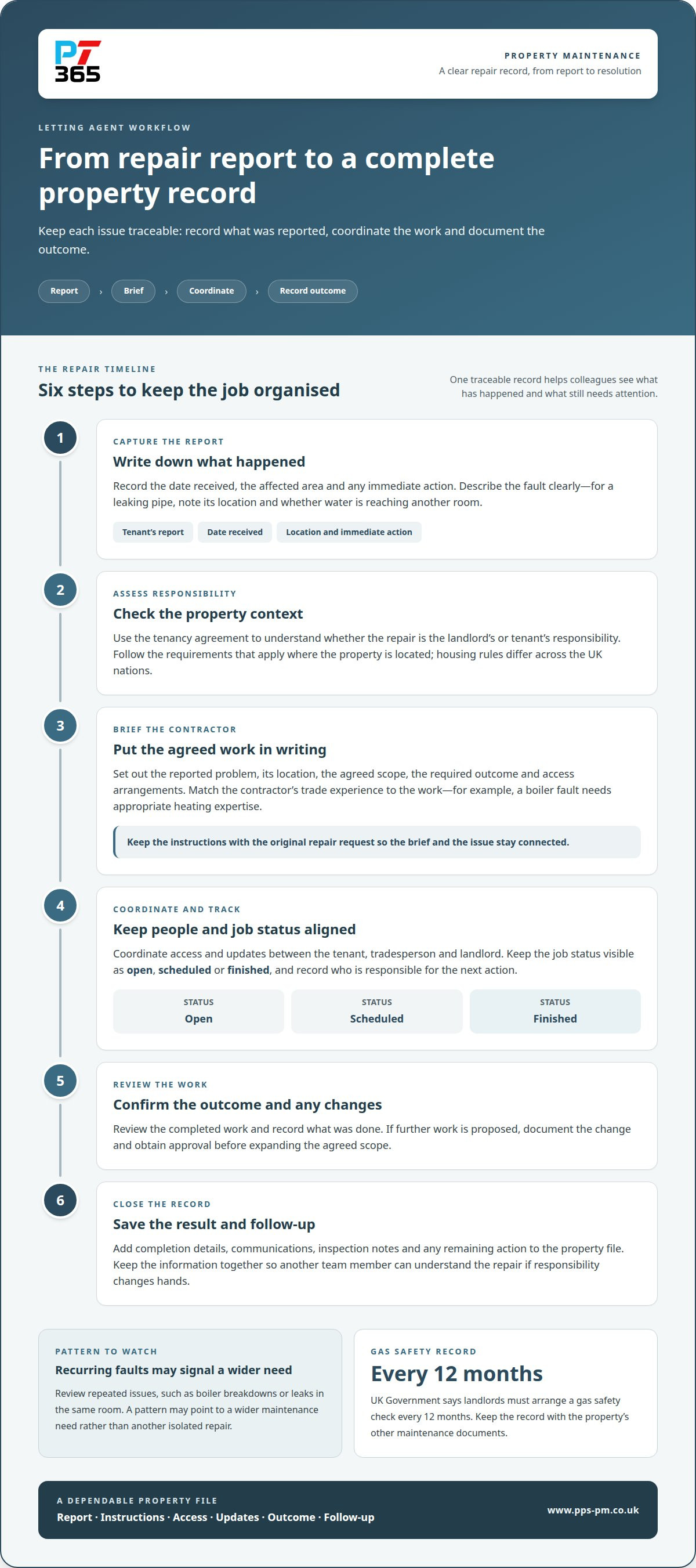
Record the tenant’s report, the date received, the affected area and any immediate action. For example, a leaking pipe needs a clear description of its location and whether water is reaching another room. Send the contractor written instructions covering the agreed scope and access arrangements. Keep updates and completion details with the original request.
Respond promptly to maintenance requests. A small leak or heating fault can worsen if left unattended, while a dated record shows how the report was handled. The tenancy agreement should explain which repairs are the landlord’s and tenant’s responsibility. Clear records help agents apply those responsibilities consistently instead of relying on informal messages or memory.
Across England, Wales, Scotland and Northern Ireland, the shared aim is to keep rented homes safe and maintained. Housing rules and enforcement processes differ between the nations, so agents should follow the requirements that apply where each property is located.
Poorly maintained rentals can leave hazards unresolved, allow damage to spread and lead to tenant disputes or regulatory action. The consequences depend on the issue and applicable rules. For example, if a tenant does not report wet rot around a window and the damage worsens, responsibility for the repair may need to be considered.
Maintenance reliability and management
A complete property file helps agents see whether a repair is open, scheduled or finished. Record the report, contractor instructions, access arrangements, work completed and follow-up required. This timeline makes handovers between staff clearer and helps prevent repeat visits caused by missing details. Reliable repair management starts with one traceable record for each issue.
Review records for recurring faults, such as repeated boiler breakdowns or leaks in the same room. Patterns may point to a wider maintenance need rather than another isolated repair. Clear evidence also helps agents explain decisions to landlords and tenants. Coordinated repair management depends on keeping the issue, actions and outcome together.
Keep inspection notes, tenant communications and tradesperson updates alongside repair records. Give tenants a clear way to report problems and encourage them to do so early. When work is finished, record the outcome and any remaining action. These steps create a dependable maintenance history for each rental property and make follow-up easier to organise.
Should a letting agent use one maintenance contractor?
Using one maintenance company can simplify communication across a property portfolio, but a single arrangement will not suit every agency. The decision depends on the work required, property locations and the oversight your team can provide.
Contractor selection for managed portfolios
Start by mapping the portfolio’s recurring jobs, property locations and specialist needs. One maintenance company may be practical for a concentrated group of homes with common repair needs. A wider or mixed portfolio may require different trades or arrangements for different areas. Choose based on the actual work, rather than assuming one provider can handle every task.
Consider the company’s relevant trade experience, insurance, communication process and ability to provide clear job updates. A boiler fault, for example, requires appropriate heating expertise, while a damaged door needs different skills. Set out the scope in writing and agree how access arrangements and completion updates will be shared with the agency. Keep expectations consistent across properties.
A single point of contact can reduce repeated explanations and help staff follow the same process. But relying on one company can create a bottleneck if its capacity or skills do not match a particular job. A planned arrangement might use one main contact for suitable work and a defined route for specialist requirements. The priority is clear responsibility, not simply having one name.
Maintenance management and oversight
Good property management still requires a named person to oversee each repair. The property manager can assess the tenant’s report, agree the written scope with the landlord where needed, coordinate access and track progress. For a heating fault, this means keeping communication moving between the tenant, tradesperson and landlord until the work is complete.
Give tradespeople clear written directions, including the reported problem, its location and the required outcome. Review the completed work before authorising payment. If additional work is proposed, record the change and obtain approval before expanding the scope. This creates a straightforward decision trail and helps prevent misunderstandings about what was authorised.
Make the arrangement easy for staff and tradespeople to use. Record who receives requests, approves work and updates tenants. If a property manager is absent, another team member should be able to see the job status and next action. Consistent records also help identify repeated faults across the portfolio, such as recurring heating issues in one building.
Use periodic reviews to assess missed appointments, incomplete work, communication gaps and repeat call-outs. These indicators show whether the arrangement supports the agency’s workload. A contractor relationship should make property maintenance easier to manage, not remove the agent’s oversight. For a practical overview of property maintenance support, consider how a structured service could fit your portfolio.
Roofing, gas, plumbing and electrical work
Rental property checks should cover the building fabric and essential systems. Record reported faults, arrange work suited to the issue and file the outcome with the property records. A clear record helps staff distinguish a routine observation from work that needs a qualified trade. It also shows what remains outstanding after an inspection or visit.
Which property safety checks must landlords arrange, and how often? According to UK Government, landlords must arrange a gas safety check every 12 months, and an Electrical Installation Condition Report must be completed at least every 5 years. Smoke and carbon monoxide alarms should be tested on the first day of every tenancy.
For roofing, record signs such as slipped tiles, damaged flashing or water marks on ceilings. A roof leak needs prompt assessment because water may affect ceilings, walls or electrical fittings. Note the location, visible damage, inspection findings and access arrangements. If the first visit identifies further work, record the next action and who will arrange it. This gives the property manager a clear sequence to follow.
Schedule each gas safety check against the property’s due date and retain the resulting record. A boiler fault or suspected gas issue should be assessed by an appropriate professional. Keep appointment details, findings and follow-up work together. This helps staff see whether a reported issue has been resolved or still needs action, rather than relying on the tenant’s initial report alone.
Plumbing checks can cover visible leaks, taps, toilets, radiators and water pressure concerns reported by tenants. For example, record the exact location of a damp patch beneath a sink and any change since it was first reported. A tradesperson’s findings can show whether the fault is limited to one fitting or needs wider attention. Record the repair and any follow-up required.
For electrical safety, retain the EICR and record any remedial work arising from it. Electrical work that is notifiable or in a special location must be carried out by a registered person, a competent person registered with an approved self-certification scheme, or someone registered with local authority building control. Keep the relevant completion evidence with the installation records so the property file is easy to follow.
Separate routine observations from formal checks. A tenant reporting a loose socket creates a repair request, not a substitute for an electrical inspection. Record the report, arrange an assessment and track the result. For HMOs and common parts, review fire risk assessments at least annually. Keep each review date and resulting action with the relevant property records.
Choosing a property maintenance service
Choose maintenance services based on property condition, agency capacity and tenants’ reported needs. A service suited to a compact portfolio of flats may not fit scattered homes with different repair requirements. List recurring tasks, urgent faults and planned work, then identify which need specialist trades. This turns a broad search into a clear service brief. Effective property maintenance for letting agents starts with this practical assessment.
Define the work before comparing service arrangements. A portfolio, for example, may need help coordinating boiler repairs, plumbing faults and general home repairs. Separate routine maintenance from specialist work, then decide which tasks need one point of contact and which require distinct expertise. A clear scope helps prevent repeated visits and incomplete jobs.
Consider how the service manages each request from first report to completion. The process should cover receiving fault details, arranging access and reporting the outcome. If a tenant reports a radiator that stays cold, for example, the agency needs a clear route to arrange an assessment and receive an update. Decide who communicates with tenants and who records the final result.
Assess whether the service can manage the portfolio’s locations and property types. Map each address against its recurring maintenance needs and access arrangements. If one building has repeated heating faults while another needs general repairs, the service plan should reflect that difference. Judge suitability by how the work matches actual requirements, not by a broad description alone.
For work involving gas or electrical systems, relevant competence and registration matter. Match the person carrying out the work to the task, and keep required paperwork with the property records. Do not treat general maintenance experience as proof of suitability for specialist work. A routine repair brief, for example, is no substitute for an appropriate technical assessment.
Before work begins, agree how the scope, changes, approvals and completion updates will be handled. The property manager should know what requires landlord approval and how revised instructions will be recorded. Use a consistent agency process while tailoring the work plan to each property’s condition. Applicable guarantees, warranties and service contracts can also clarify responsibilities.
Compare service arrangements by scope, communication, relevant expertise, coverage and record keeping. These criteria help the agency judge practical fit instead of relying on broad claims. For an agency seeking property maintenance for letting agents, the right service is one that suits its properties and working process. Use these criteria to assess whether the proposed arrangement can support the portfolio’s actual needs.
Coordination with estate agents and tradespeople
Clear coordination connects the tenant’s report with the right trade, access arrangements and completed work. Estate agents, property managers, landlords and tradespeople each need a defined role, especially when several people handle one repair.
Start with one recorded request for each fault. The agent captures the tenant’s description, property address, affected room and access details, then assigns the job to the appropriate trade. A failed boiler needs a heating engineer, for example, while a dripping kitchen tap needs a plumber. A clear handover prevents incomplete or conflicting instructions.
Agree who will update the tenant and landlord before arranging attendance. The property manager can confirm access, pass on relevant details and keep both parties informed if further work is identified. For a flat, for instance, entry may need to be coordinated with a tenant, building manager and attending tradesperson. Record the agreed arrangements in the job file.
Written instructions help tradespeople understand the required outcome. Include the reported issue, its location, relevant inspection findings and the authorised work. If a separate fault is discovered, the tradesperson should report it before the scope changes. The agent can then record the decision and share updated instructions instead of leaving the tradesperson and tenant to interpret an informal conversation.
Use a consistent update process for jobs involving several trades. A roof leak affecting an internal ceiling might require a roofing assessment followed by repairs inside the property. Track the order of tasks, the access each trade needs and whether the next tradesperson can proceed. This sequence avoids duplicated visits and makes delays visible.
Proactive coordination means identifying dependencies before booking work. A plumber replacing a radiator may need access to the room and heating controls; a decorator should not be booked until the repair is complete. Note these dependencies in the work plan to avoid scheduling trades in the wrong order.
After attendance, record the tradesperson’s findings, work completed and any remaining action. Tell the tenant whether another visit is planned, and update the landlord when a decision is needed. Use the same process across the portfolio, noting each property’s access arrangements and local contact details. This gives colleagues a practical handover when responsibility changes.
Need a clearer process for coordinating property work? Arrange property maintenance support and keep communication between agents and tradespeople moving.
We are a trusted Property Maintenance company providing reliable, high-quality services across London and Kent
We are a trusted Property Maintenance company providing reliable, high-quality services across London and Kent, supporting letting agents with practical property maintenance and repair coordination. The team can help with plumbing, heating and boiler servicing when a rental property needs attention, giving agents a clear route to discuss the work and its requirements.
Share the property details and the issue to help establish a useful next step. Contact We are a trusted Property Maintenance company providing reliable, high-quality services across London and Kent to discuss support for your managed properties.
Put a clear maintenance process into practice
Effective property maintenance for letting agents starts with deciding how requests move from the first report to a completed job. Set a consistent route for urgent faults, planned work and follow-up, then make responsibilities clear across the agency. This gives each repair a defined next step and helps staff maintain continuity when workloads change.
Use the process to identify which jobs need specialist attention and what information each instruction must include. The tenant’s report, property details and required work should give the attending tradesperson a clear starting point. Keep the system simple enough for colleagues to use during busy periods, not just when the same person handles every request.
We are a trusted Property Maintenance company providing reliable, high-quality services across London and Kent that can support letting agents with property maintenance needs, including plumbing and heating work. If you’re ready to discuss how your managed properties could be supported, talk through your maintenance requirements. A clear next step can make the work ahead easier to organise.
Frequently Asked Questions
What Do Property Maintenance Companies Do?
Property maintenance companies organise repairs and planned upkeep for homes and buildings. Their work can include assessing reported faults, arranging suitable trades, coordinating access and communicating progress. Some also support inspections or maintenance between tenancies. After a tenant moves out, for example, an agent may arrange repairs to a damaged door before the next tenancy begins. The precise work depends on the property and agreed service scope.
Does a maintenance partner need to be local?
Not necessarily, but coverage and coordination must suit the properties being managed. A maintenance company serving a wider area may suit a portfolio spread across different towns, provided it can organise attendance and communicate clearly. A local company may be practical for a concentrated group of homes. Consider travel between addresses, access arrangements, trade requirements and how updates reach your team before choosing.
Need support with maintenance for a London letting portfolio?
Plumbfix 365 provides property maintenance support across London and Kent, including plumbing and heating services. For a London portfolio, this can help with issues such as a leaking pipe, a heating fault or planned boiler servicing. Share the property location, reported problem and any access details when discussing the work. This gives the team useful context for considering the next practical step.
What should a reliable maintenance process look like?
A reliable process gives every repair a clear route from initial report to final update. First, classify the issue by trade and urgency. Then establish who can approve the work, arrange access and receive progress updates. After attendance, record the outcome and any outstanding action. If an inspection identifies a second fault, for example, record the decision before arranging separate work.
Who is responsible for repairs: the landlord or the letting agent?
Landlords are generally responsible for maintaining the property’s structure and essential systems, while a letting agent may coordinate repairs under the management agreement. The agreement should clarify who receives reports, approves work and communicates with tenants. An agent might arrange an inspection but need the landlord’s approval before additional work. Delegating administration does not automatically change the landlord’s underlying repair responsibilities.
What property maintenance services do letting agents typically provide in the UK?
Letting agents commonly arrange repairs and upkeep on a landlord’s behalf rather than carrying out every trade themselves. Depending on the property and agreement, this may involve plumbing, heating, general home repairs, inspections or work between tenancies. An agent might coordinate a reported boiler fault, arrange access and pass updates between tenant and landlord. The specific scope depends on the management service agreed with the landlord.
What are a letting agent’s legal responsibilities for property maintenance and repairs in England?
In England, an agent’s responsibilities depend on its agreement with the landlord and any authority delegated to it. Landlords remain responsible for maintaining the property’s structure and systems supplying water, gas and electricity, as well as sanitation facilities, in safe working order. Agents acting for landlords should handle reported issues in line with their agreed role, communicate clearly and escalate decisions requiring the landlord’s approval.
How quickly must landlords or letting agents respond to emergency and routine repairs?
Handle maintenance requests promptly, prioritising them according to the risk and effect of the fault. A serious leak affecting electrical fittings needs urgent attention; a minor cosmetic defect can usually be assessed through routine maintenance planning. Acknowledge reports, establish the issue’s impact and communicate the next step. Keep tenants informed if access or further assessment affects the repair schedule.


Comments